What Actually Fails in the Field
Teardown analyses of returned cables nearly always land on the same four failure modes:
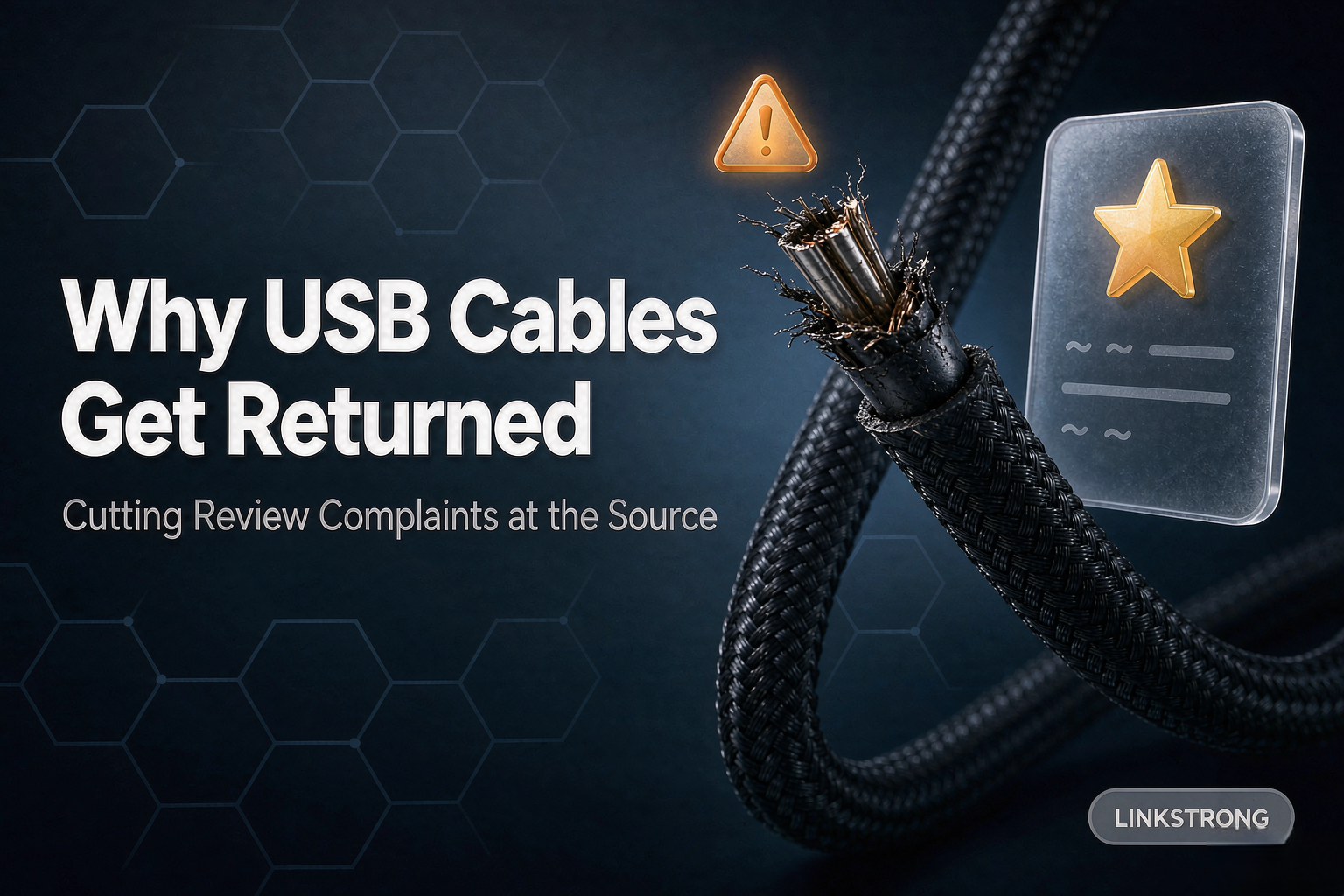
- Strain relief failure. The jacket cracks where the cable exits the plug. Bending stress concentrates at that point thousands of times; a stiff or short strain relief guarantees a fracture. This is the single most common physical failure and the most preventable — see our note on strain relief design.
- Connector wear and looseness. The USB-C tongue loses spring force, the plug wobbles, contact resistance climbs, charging cuts in and out. Cheap plating and off-spec contact parts age fast.
- Internal conductor breakage. The cable still looks fine but no longer carries data or fast charge. Usually the result of thin copper, poor stranding or a jacket that transmits bending stress to the conductors.
- Jacket damage. Pet bites aside, thin PVC cracks in cold climates and abrades in bags — a real issue for a braided-vs-PVC comparison, covered in our jacket material guide.
Notice what is absent: electronics. A passive cable has no components to fail except the E-marker, which almost never does. Cables fail mechanically. That is good news, because mechanical failure is predictable and specifiable against.
"Slow Charging" Is Usually a Specification Problem, Not a Defect
The most damaging review category is not breakage — it is the complaint that never would have existed with the right specification. A customer plugs a 60W cable into a 100W charger and the phone charges at 60W minus losses. Nothing is broken; the product simply cannot do what the buyer assumed it could.
Three specification slips cause nearly all "slow" reviews:
- The cable is rated below the charger. If the listing shows a 96W or 140W charger in the lifestyle image but ships a 3A cable, reviews will say so.
- No E-marker where one is needed. Above 3A, the chip — not the copper — unlocks the wattage. More on this in our E-marker guide.
- Long cables with thin conductors. Voltage drop grows with length and resistance, so a 3m 28AWG cable can charge measurably slower than a 1m 20AWG one. The physics is in our voltage drop guide and the practical side in the cable length guide.
The fix costs nothing at design time: match the advertised wattage tier, the E-marker, the wire gauge and the length as one coherent spec.
Turning Reviews into Specifications
The productive move is to read your category's negative reviews (yours and competitors') as a requirements document. The mapping is direct:
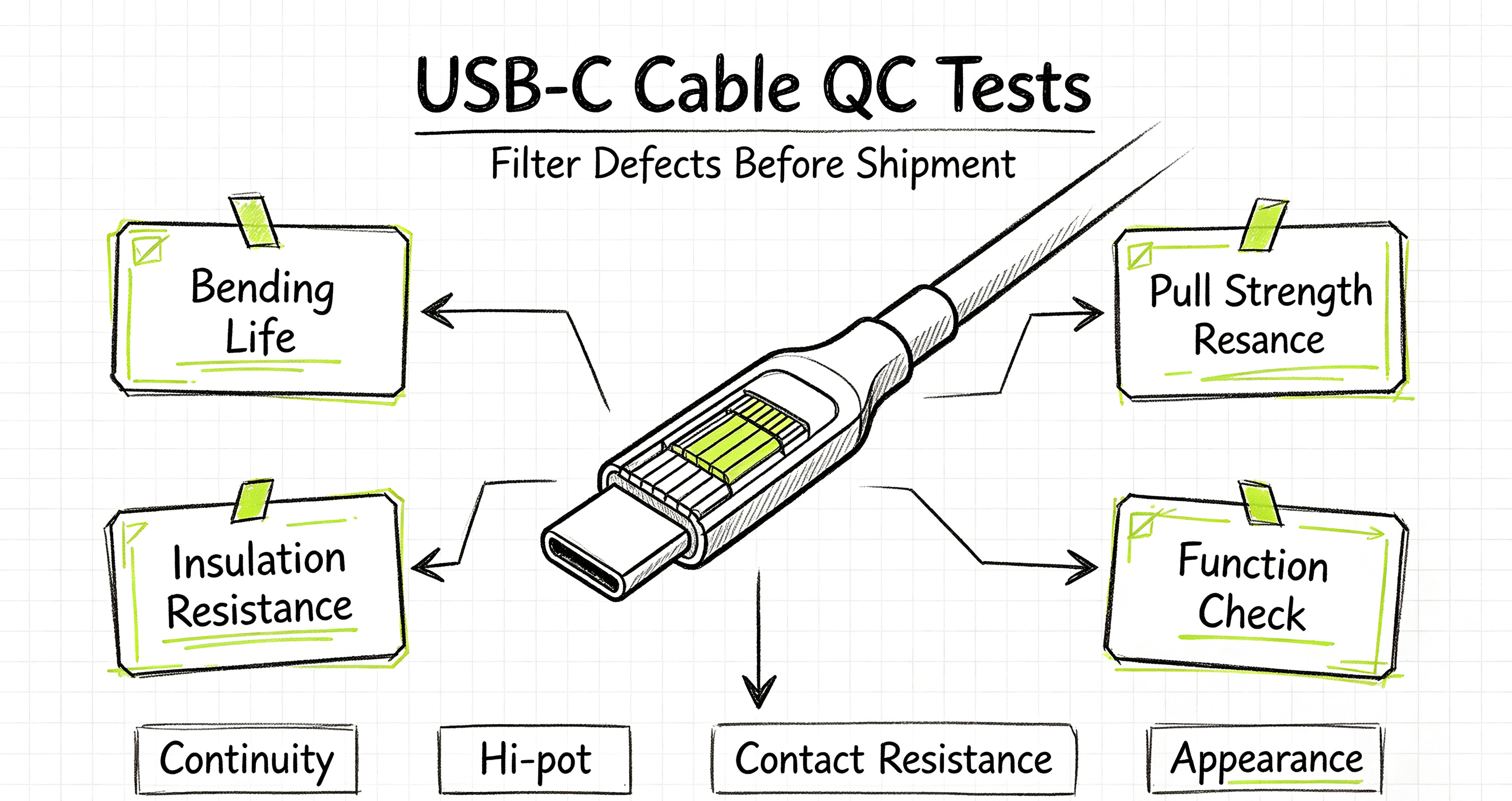
- "Stopped working near the plug" → specify strain relief length and material, and require bend test data (cycles at a defined angle and load).
- "Loose connection" → specify contact plating thickness and insertion-cycle count, and ask for pull-force and insertion test data.
- "Slow charging" → lock the wattage tier: conductor spec, E-marker rating and length together, verified with a PD analyser screenshot.
- "Frayed cable" → specify jacket type and braid coverage, with abrasion test results.
Then make these pass/fail items in the pre-shipment batch QC, not aspirations. A supplier who already runs failure analysis on returned units will recognise the vocabulary immediately; one who does not will find it awkward — which is itself useful information about who you are buying from.
A Pre-Order Checklist
Before the next PO, five questions, each answerable with a document rather than a promise:
- Bend test: how many cycles, at what angle and load, on which sample size?
- Pull test and insertion cycles: what numbers, and can we see the report?
- Wattage claim: analyser screenshot of the negotiated PD contract at max tier?
- Jacket and strain relief: material callouts on the drawing, not just photos?
- Batch QC: what is tested on every shipment, and who signs it?
None of this is exotic. It is the difference between a cable line that quietly accumulates 4.6 stars and one that keeps generating the same complaints in the same words. Specify against the failure, verify the spec on samples, and the reviews take care of themselves.