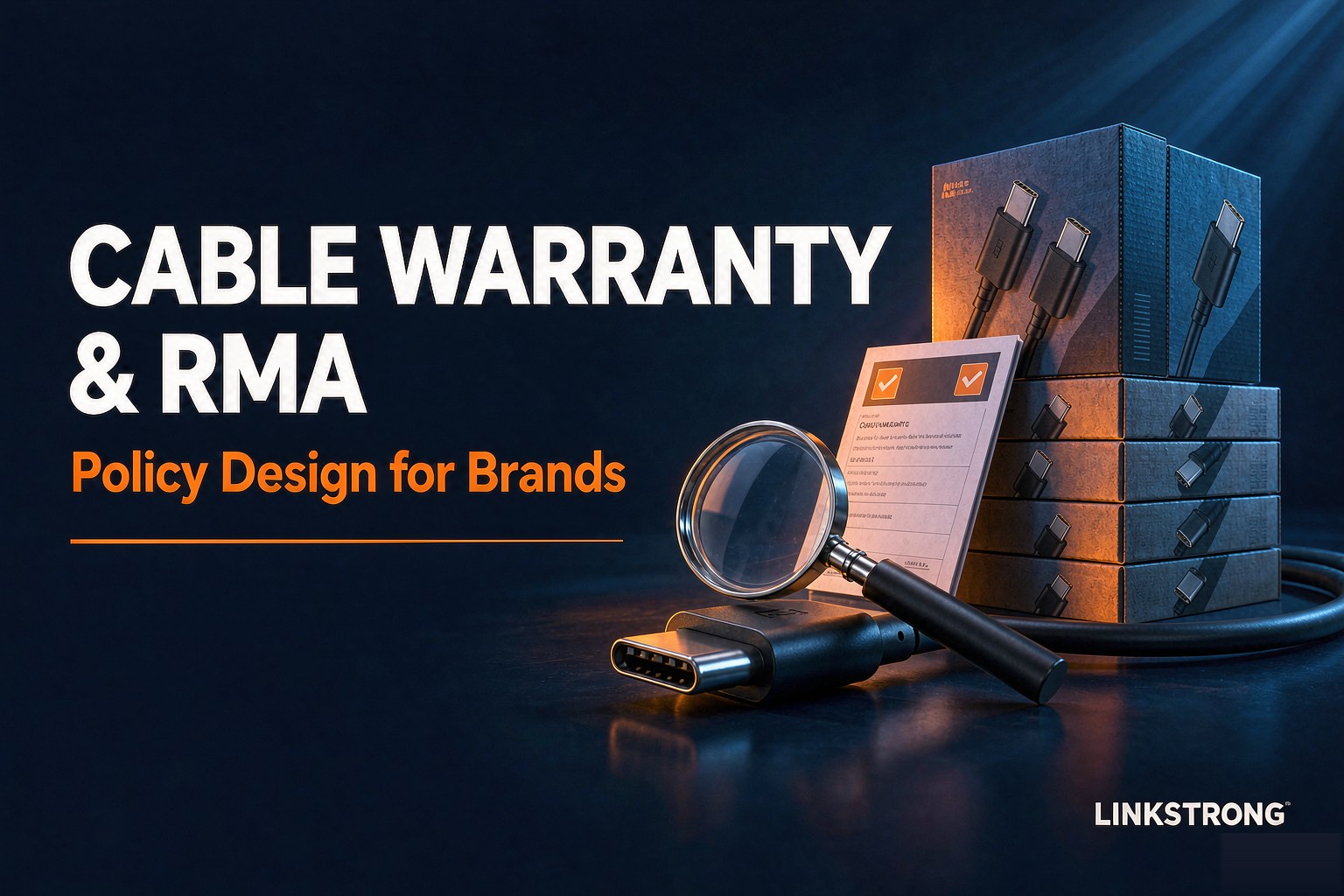
Why Warranties Are a Margin Question, Not a Legal One
Cable failure rates are low but never zero, and unlike most products, cables are used harder than anything else in a consumer's bag: bent, coiled, yanked, run over by chairs, and plugged in hundreds of times. If your policy promises a no-questions replacement on every failure, you are not just covering defects — you are absorbing every case of customer abuse. That can be fine, if you priced it in. The mistake is launching with a 5-year "premium" warranty on a value-tier cable and discovering a year later that RMA costs have eaten the category's profit.
The right starting point is knowing what failure actually costs you: replacement unit, outbound shipping, handling time, and — on marketplaces — the possible hit to your listing metrics. Multiply by your expected failure rate, then decide whether the warranty term earns its keep in conversion.
Realistic Defect and Return Benchmarks
Numbers vary by construction and price tier, but professional factories work with these rough expectations:
- Early-life failure (first 30 days): under 0.3% for a properly tested production batch. Spikes above this usually mean a batch problem, not a design problem.
- 12-month cumulative failure: roughly 0.5%–1.5% for a well-built cable with molded strain relief; braided-jacket designs often land at the low end.
- Marketplace return rate: cables sold on Amazon commonly see 2%–5% returns for all reasons, including "wrong length" and buyer's remorse — only a fraction are true defects.
If your real numbers sit far outside these bands, the fix is usually engineering, not policy. Our guides on root-cause analysis for USB-C cable failures and strain-relief design cover the two failure points that dominate real-world warranty claims.
Designing Warranty Tiers That Protect Margin
Most successful brands run a two- or three-tier structure:
- Base tier (12–18 months): covers manufacturing defects — dead shorts, connector separation, intermittent charging caused by internal damage. Abuse is excluded, and the burden of proof stays reasonable.
- Premium tier (2–5 years): offered on heavy-gauge or reinforced lines where the bill of materials supports the promise. This is a marketing asset only if the construction genuinely differs.
- Marketplace overlay: on Amazon, a fast "we'll just replace it" reflex for claims under a certain dollar value often beats arguing, because negative reviews cost more than cables.
Whatever tiers you choose, write down what is excluded — physical crushing, liquid damage, altered connectors — and say it in plain language on the listing and package insert.
Building an RMA Loop That Improves the Product
The brands that win treat every returned cable as free failure data. A useful loop looks like this: collect the return reason at the moment of claim; physically inspect a sample of returned units monthly; log failure mode (connector, strain relief, jacket, electronics) against batch numbers; and review the log with your factory every quarter. Over six months, this tells you whether failures cluster in a batch — which points to process control — or across all batches, which points to design.
Batch-level tracking only works if your factory runs structured outgoing inspection. Our article on USB cable quality control batch tests describes the checks a professional line should run before shipment.
Making the Factory Accountable
A warranty policy is only as good as the factory agreement behind it. Push for three clauses: a defect allowance (typically 0.3%–0.5% at no charge, with replacements shipped in the next production run), a requirement to retain retains of each batch for a defined period so failures can be verified, and corrective-action obligations with a stated response time when a failure cluster is confirmed. Our overview of custom cable MOQs and terms for brand buyers explains how these clauses fit into a standard OEM agreement.
Handled this way, warranty stops being a cost center and becomes the feedback engine that makes version two of your cable genuinely better — and a documented failure history makes your next factory negotiation noticeably easier. If you want a factory partner that accepts defect allowances and batch accountability in writing, talk to the LINKSTRONG team — we build these terms into custom cable programs for US brands every month.