This guide explains the mechanism, what the practical difference is between 3ft, 6ft and 10ft, and how US brand buyers should specify length and gauge so a long cable still hits its advertised charge rate.
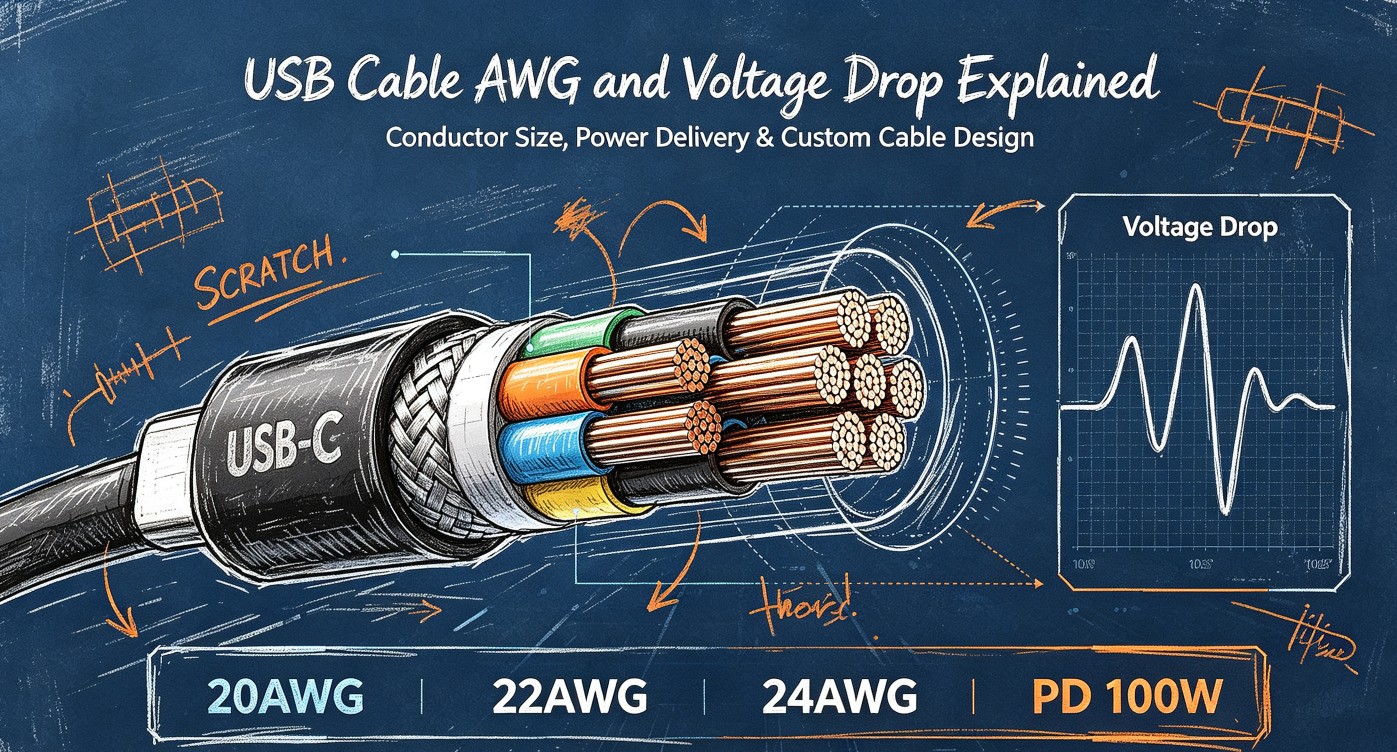
The Mechanism: Resistance, Not Magic
A conductor has resistance proportional to its length. Double the length and you double the resistance. Under load, that resistance drops part of the charger's output voltage before it ever reaches the device:
- A charger delivers, say, 20V.
- The cable's conductors lose some of it as heat.
- The device receives a lower voltage — and if it falls below what the device needs, the device reduces the current it draws, which reduces the delivered power.
This is voltage drop, and it is cumulative with every foot. It also matters that USB-C PD cables carry power on the VBUS/GND pair, which must be sized for the current — not the data lines, which carry almost no power.
Rules of thumb:
- Voltage drop rises with length (proportional to conductor length).
- Voltage drop rises with current (proportional to current).
- Voltage drop falls with thicker copper (proportional to cross-sectional area, i.e. smaller AWG).
So a long cable is not inherently bad — it is bad if the gauge is not increased to compensate.
What 3ft, 6ft and 10ft Actually Do
For a cable built to the same gauge, the practical reality:
| Length | Typical use | Behaviour on a high-power load |
|---|---|---|
| 3ft (1m) | Charging at a desk or in a car | Closest to the charger's rating; lowest drop |
| 6ft (2m) | The US volume SKU — sofa, bedside, office | Slight drop; fine if gauge is correct |
| 10ft (3m) | Reaching across a room or bed | Noticeably more drop; needs heavier gauge or the device throttles |
A well-engineered 10ft 100W cable uses heavier conductors than a 3ft 100W cable for exactly this reason. If a supplier uses the same gauge across all lengths, the 10ft version is where customers will complain.
You can see the same principle in reverse in our USB 2.0 vs USB 3.2">USB cable AWG and voltage drop guide: gauge and length are two sides of one equation.
<h2>Gauge Selection by Length and Power</h2>
Approximate starting points for USB-C PD cables (verify with an actual voltage-drop measurement at rated current):
(news_detail.php?slug=usb-2-0-vs-usb-3-2-cable-guide) for that side.
Why Longer Cables Sometimes Fail Negotiation
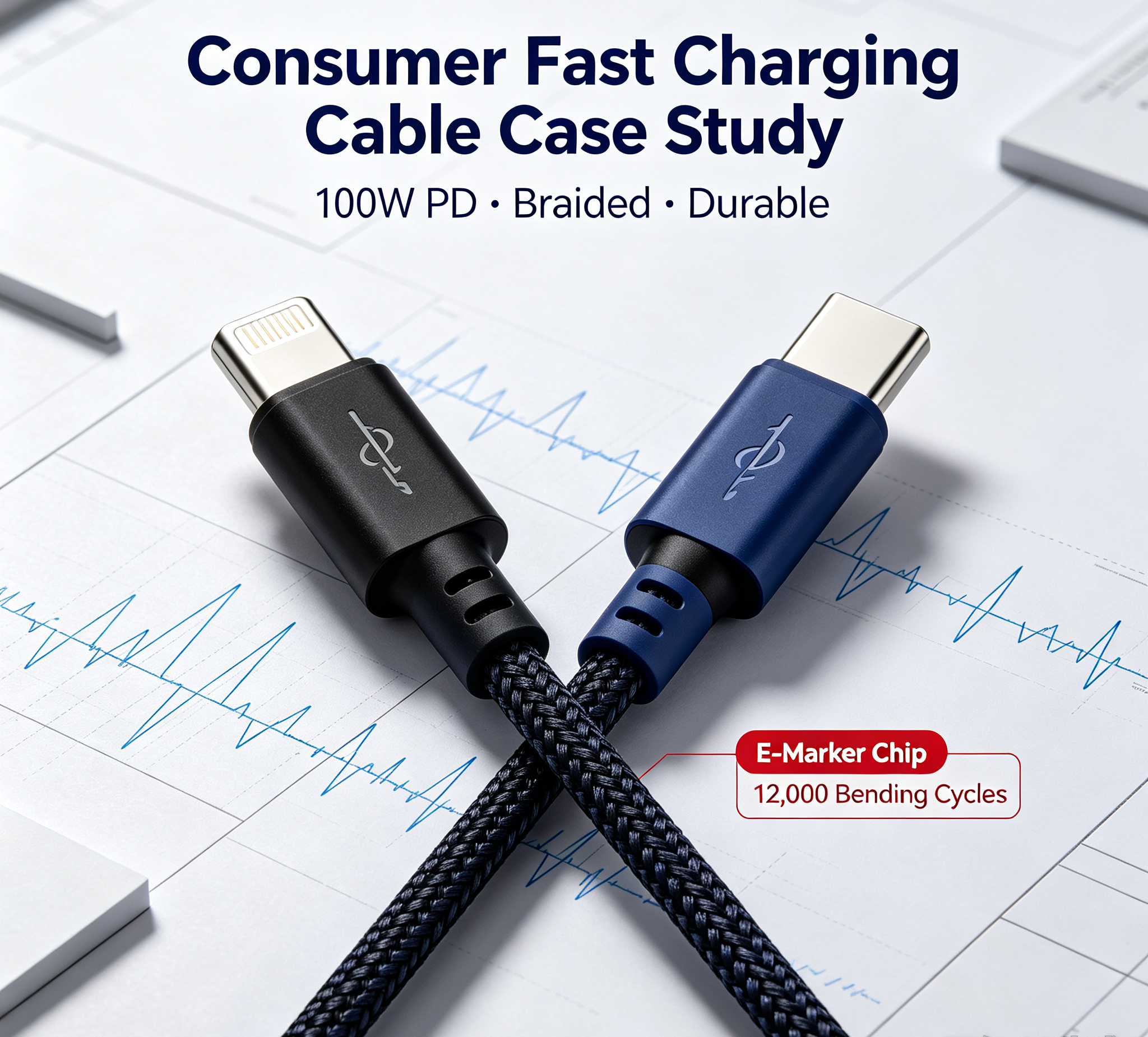
There is a second effect beyond voltage drop. USB-C PD negotiation depends on the E-marker chip inside the connector reporting the cable's capability. On long cables the signal integrity of the configuration channel can degrade enough that negotiation falls back to a lower power tier, or the device simply charges slower. This is why two cables with identical printed ratings can behave differently at 10ft — the difference is construction quality, not the label.
The practical lesson for buyers: specify the charge performance you need at the length you are selling, and ask for a voltage-drop test at that length. Do not accept a "1m test" extrapolated to a 3m product.
What This Means for US Retail SKUs
If you sell into the US, the three lengths are usually three separate SKUs, and each needs its own specification:
- 3ft — the travel and automotive SKU. Gauge can be lighter; the buyer expects a compact cable.
- 6ft — the volume SKU. This is where most sales are, and where a small gauge upgrade is worth the cost because it protects your reviews.
- 10ft — the "reach" SKU. Budget for heavier copper. If you price it like the 6ft version without upgrading the gauge, the returns will eat the margin.
For multi-packs, keep the lengths honest: a "3-pack" that is actually 3ft / 6ft / 10ft should say so, and each unit should meet its own rating.
How to Test It Before Mass Production
Ask your supplier for:
1. A voltage-drop measurement at rated current over the full production length — not a calculated figure.
2. A charge-rate test on a real device at that length, photographed or filmed.
3. The E-marker read-out confirming the cable declares its rating on the long version too.
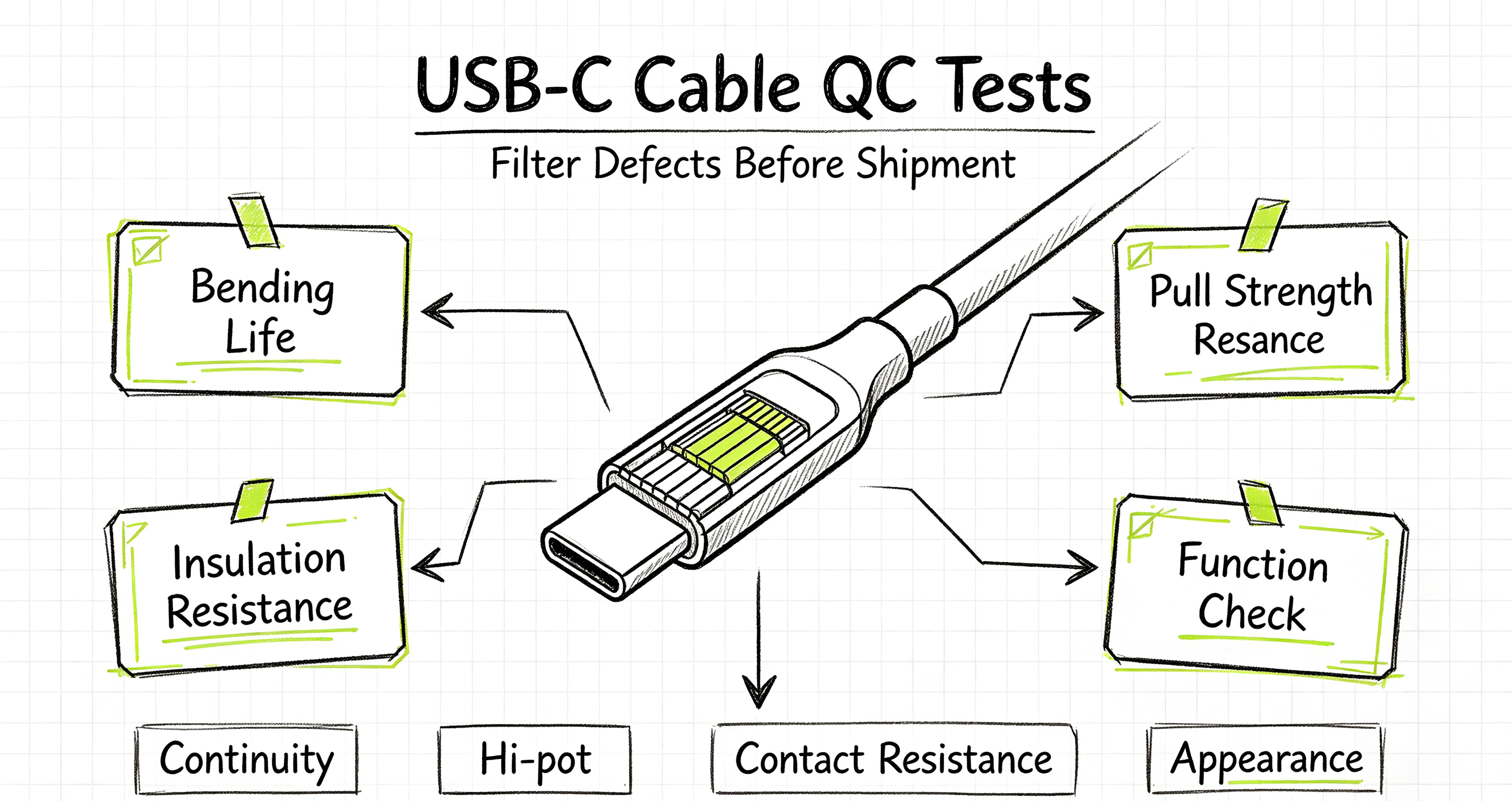
4. A temperature-rise check at rated current — long, thin cables are where heat builds up, and it is also a UL 9990 test item.
A supplier who tests only the short sample and promises the rest is asking you to absorb the risk.
Common Mistakes
- Same gauge for every length. Cheapest on paper, most expensive in returns.
- Assuming 240W fixes length. Higher voltage EPR helps, but long thin cables still drop.
- Confusing charging and data. A cable can be fine for 100W charging and poor for 10Gbps data at the same length.
- Publishing one spec across a length range and then fielding "doesn't fast charge" reviews on the long one.
Specifying Length and Gauge for Your Market
LINKSTRONG builds 3ft, 6ft and 10ft USB-C cable ranges for US sellers, matching conductor gauge to the length and power rating so the long SKU charges like the short one — and supplying the voltage-drop and temperature-rise data to prove it. If you are planning a length range for the US market, send us your target ratings and lengths, or review our USB-C cable power ratings guide first.