Content Text
Most USB cable field failures occur at the connector root. Cracked jackets, broken internal wires, loose plugs, and intermittent charging issues are almost always caused by poor strain relief design.
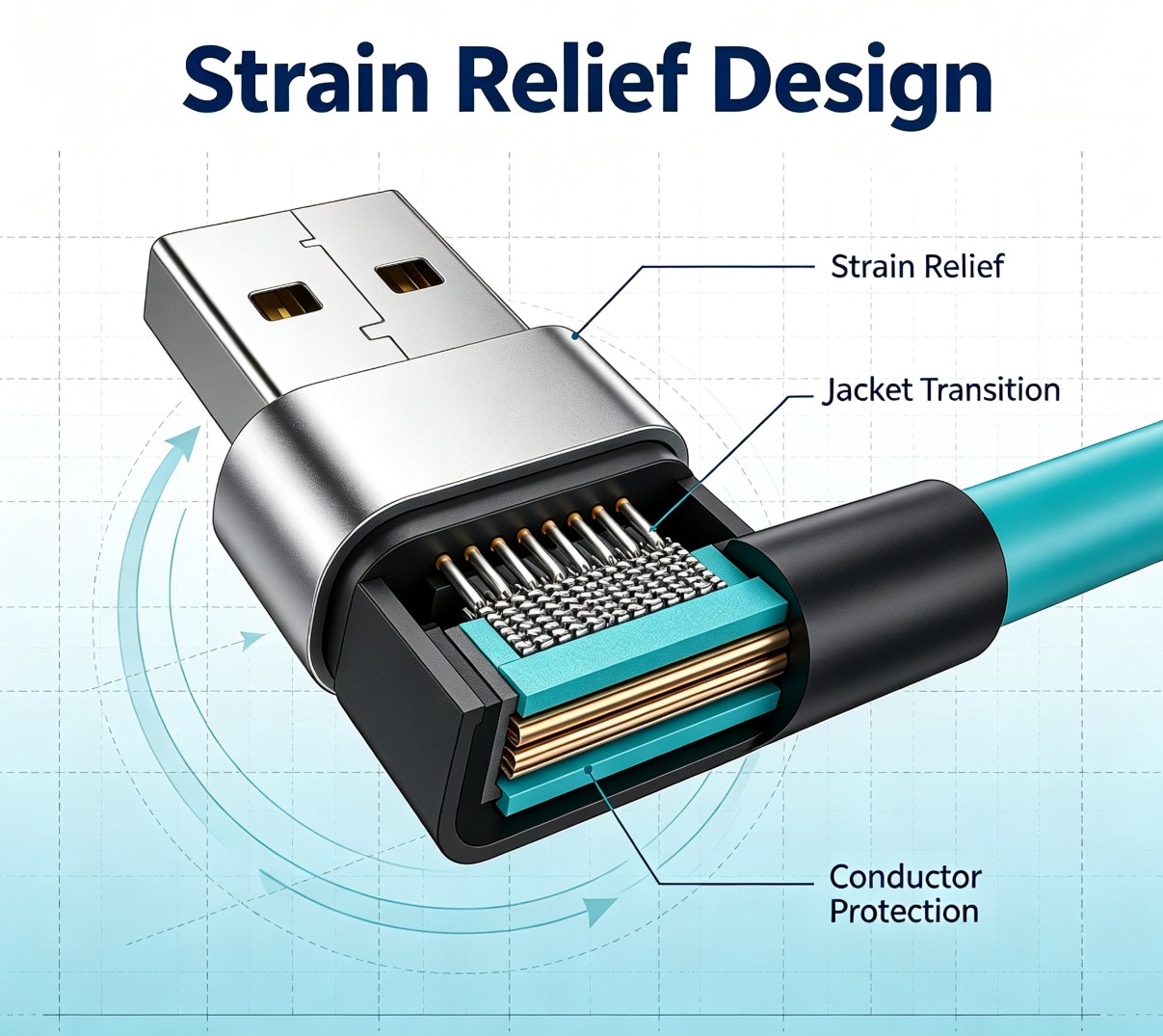
Strain relief refers to the reinforced rubber / TPE over-molding section at the cable plug. It absorbs bending stress, protects internal conductors, and prevents rigid concentrated bending at the connector junction.
This article explains professional USB cable strain relief structures, design standards, failure causes, and optimization methods for custom cable projects.
1. Why Strain Relief Is the Most Critical Part of USB Cables
The connector metal shell is rigid, while the cable body is flexible. Without proper strain relief:
- All bending force concentrates on one tiny line at the plug root
- Repeated flexing cuts internal copper wires
- Jacket cracks after thousands of bends
- Solder joints break loose, causing intermittent charging or dead cables
In our previous USB-C cable failure analysis guide, strain relief defects rank No.1 field failure root cause for consumer and industrial USB cables.
2. Common Strain Relief Structure Types
2.1 Straight Strain Relief (Basic)
Smooth straight rubber extension at the plug tail.
- Pros: Low cost, simple molding
- Cons: Poor flexibility, easy to crack under frequent bending
- Application: Low-budget static-use USB 2.0 cables
2.2 Corrugated / Ribbed Strain Relief
Wave-shaped ribbed structure for flexible deformation.
- Pros: Disperse bending stress, greatly improve bend life
- Cons: Higher mold cost
- Application: Daily charging cables, USB3.2 data cables
2.3 Long Flexible Strain Relief
Extended soft TPE relief section (15mm–25mm).
- Pros: Distribute bending arc over a long range, ultra-high durability
- Cons: Larger outer size
- Application: Industrial cables, frequent plug-in flex scenarios, high durability custom projects
2.4 Double-Layer Hard + Soft Relief
Hard plastic fixed base + soft TPE flexible outer layer.
- Pros: Anti-pull, anti-twist, anti-break
- Application: Medical equipment, vehicle USB, rugged industrial cables
3. Standard Design Parameters for Custom USB Cables
Professional manufacturers follow fixed strain relief rules:
- Length: 12mm–22mm (longer = more durable)
- Material: Soft TPE / PUR (hard PVC is forbidden for flex cables)
- Transition gradient: Smooth transition from plug shell to cable OD
- Wall thickness: Uniform thickness to avoid weak points
- Molding temperature control: Prevent material aging and brittleness
Poor molding temperature will cause brittle relief rubber, refer to our USB cable jacket material guide for material hardness selection.
4. Typical Failure Modes Caused by Bad Strain Relief
1. Plug wobble & loose connection
No inner reinforcement leads to connector shaking during bending.
2. Root wire fracture
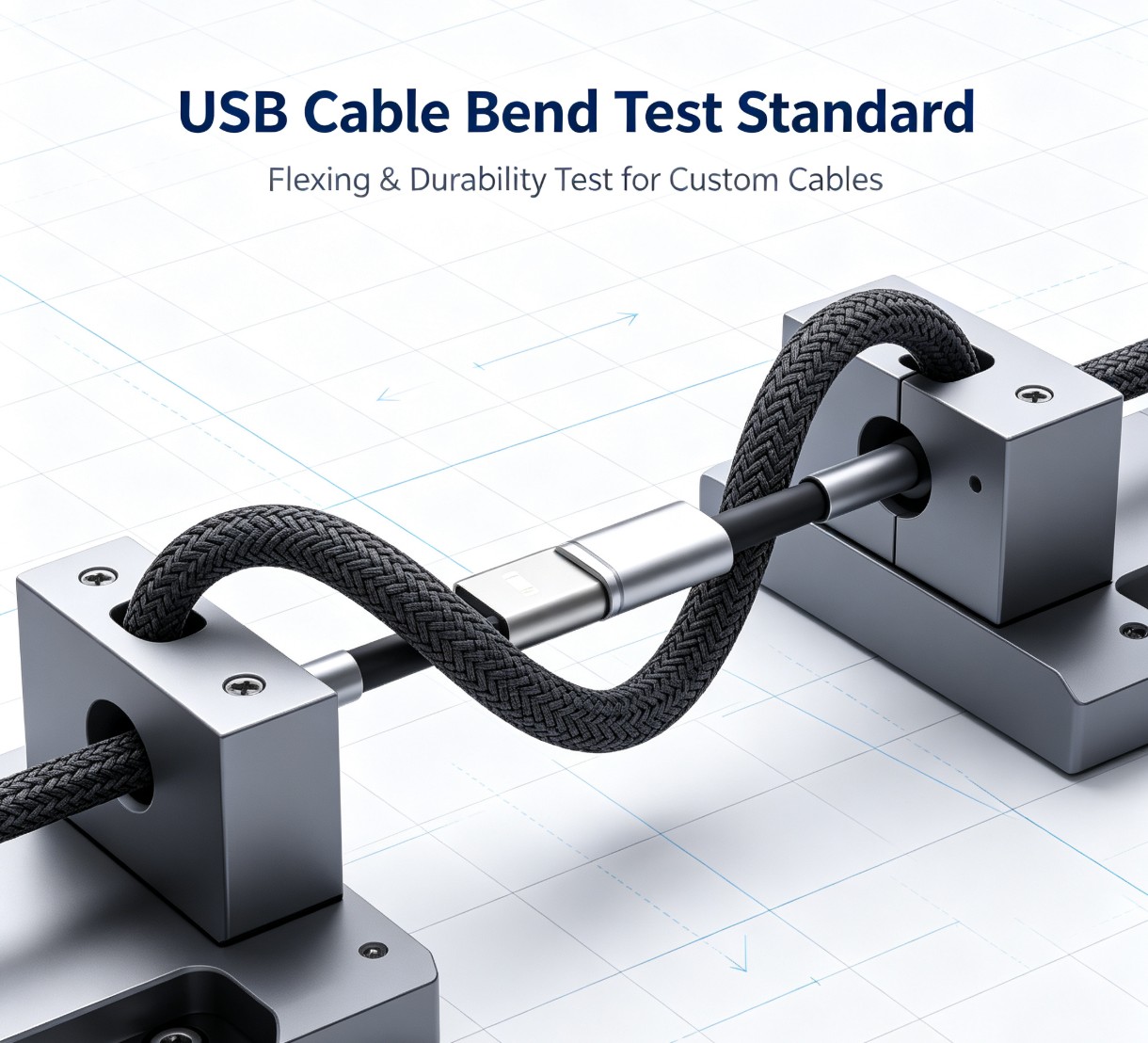
Concentrated bending stress cuts VBUS/GND core wires — one of the most common defects in bend test failure, see USB cable bend test standard.
3. Jacket split & peeling
Bad bonding between over-mold and cable outer jacket causes layer separation.
4. Intermittent power delivery
Broken tiny data/CC wires inside lead to unstable fast charging and data dropout.
5. How LINKSTRONG Optimizes Strain Relief Design
For every custom USB cable project, our engineering team customizes strain relief solutions based on usage scenarios:
- Static equipment use → cost-effective ribbed relief
- Daily frequent bending → long soft TPE relief
- Industrial / vehicle / rugged environment → double-layer hard+soft anti-stress structure
We strictly control over-mold injection parameters in the USB-C cable manufacturing process to avoid brittle relief and poor bonding.
All finished cables pass strict mechanical durability tests in USB-C cable quality control batch tests.
6. Custom Strain Relief for Your Project
If you need high-durability USB cables with anti-break strain relief structure for consumer electronics, medical, or industrial devices, contact LINKSTRONG custom cable team to customize structural design.
Before confirming technical specifications, check our custom cable assembly RFQ guide to list all mechanical and environmental requirements.