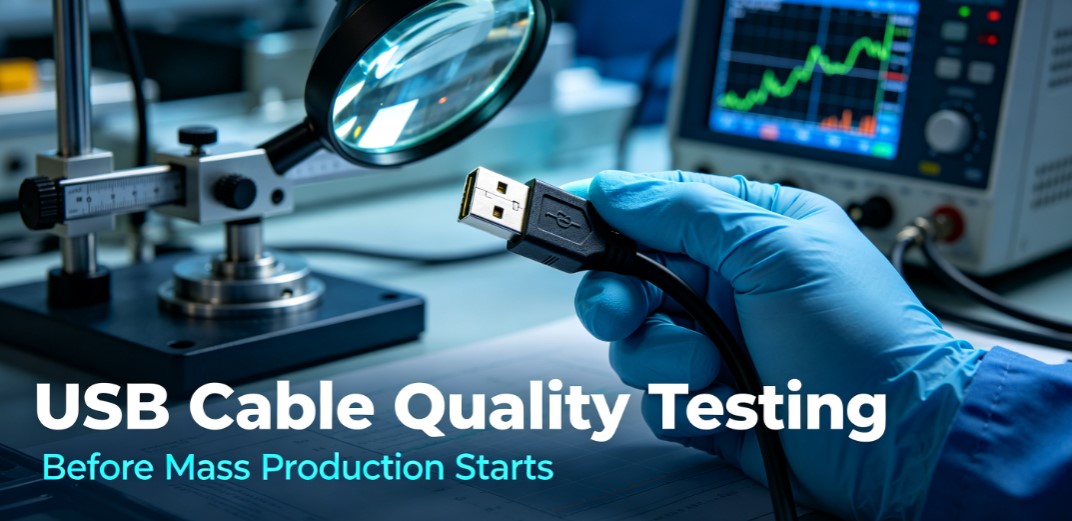
For consumer electronics brands, understanding cable QC standards helps you evaluate suppliers, define acceptance criteria and control after-sales risk. Below are the core tests every USB-C cable batch needs to complete.
1. Electrical Performance Tests (100% Inline Test)
Electrical tests are performed on every finished cable to catch wiring defects.
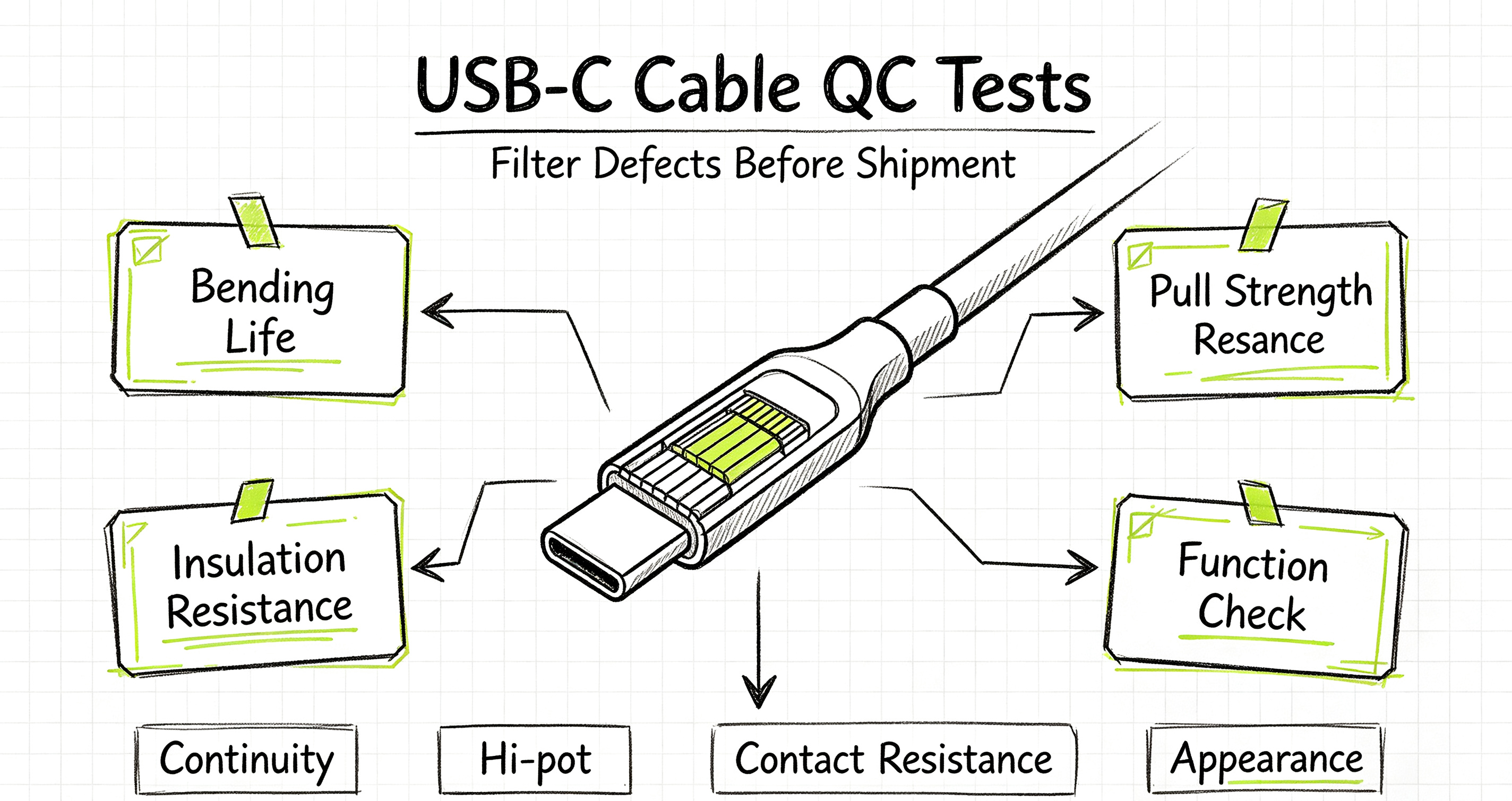
- Continuity & Open/Short Circuit Test: Check broken conductors and short circuits caused by soldering mistakes. This is the most basic test to rule out dead cables.
- Contact Resistance Test: High contact resistance will lead to heat buildup and power drop during fast charging. This test ensures stable current delivery for 60W / 100W PD charging. For more on how conductor thickness affects charging performance, read our guide on USB cable AWG and voltage drop.
- Insulation Resistance & Hi-pot Test: Verify insulation integrity to prevent leakage risk and meet global safety requirements.
- Power & Data Function Test: Validate actual fast charging output and USB 2.0 data sync performance, matching the cable specification you ordered. If you are unsure about data speed differences, see our USB 2.0 vs USB 3.2 cable guide.
2. Mechanical Durability Tests (Sampling Test)
Mechanical reliability tests are sampled from each production lot, simulating daily rough usage by consumers.
- Bending Life Test: Repeated bending at the strain relief area. As mentioned in our custom USB cable case study, premium consumer cables are required to pass over 10,000 bending cycles without internal wire breakage.
- Tensile / Pull Test: Test the bonding strength between cable and molded connector to avoid separation under pulling force.
- Connector Insertion & Extraction Test: Simulate thousands of plug/unplug cycles to check connector retention force and pin stability.
- Torsion Test: Twist the cable repeatedly to check jacket cracking and internal conductor damage. Jacket material choice has a major impact on crack resistance — compare PVC, TPE, PUR and XLPO jacket materials in our detailed guide.
3. Environmental Aging Tests (Sampling Test)
Environmental tests expose cables to extreme conditions to verify long-term stability, suitable for products sold in high-temperature regions such as Africa and the Middle East.
- High and low temperature storage test
- Thermal cycling test (alternating hot & cold environment)
- Damp heat aging test
These tests confirm the cable maintains stable performance after long exposure to changing ambient temperatures and humidity.
4. Appearance & Dimension Inspection
Visual and dimensional inspection checks:
- Cable total length, outer diameter consistency
- Jacket surface scratches, bubbles or discoloration
- Mold flash at connector housing
- Clear laser marking or printing without blur
- Uniform color matching for custom brand cables
Full Batch QC Workflow at LINKSTRONG
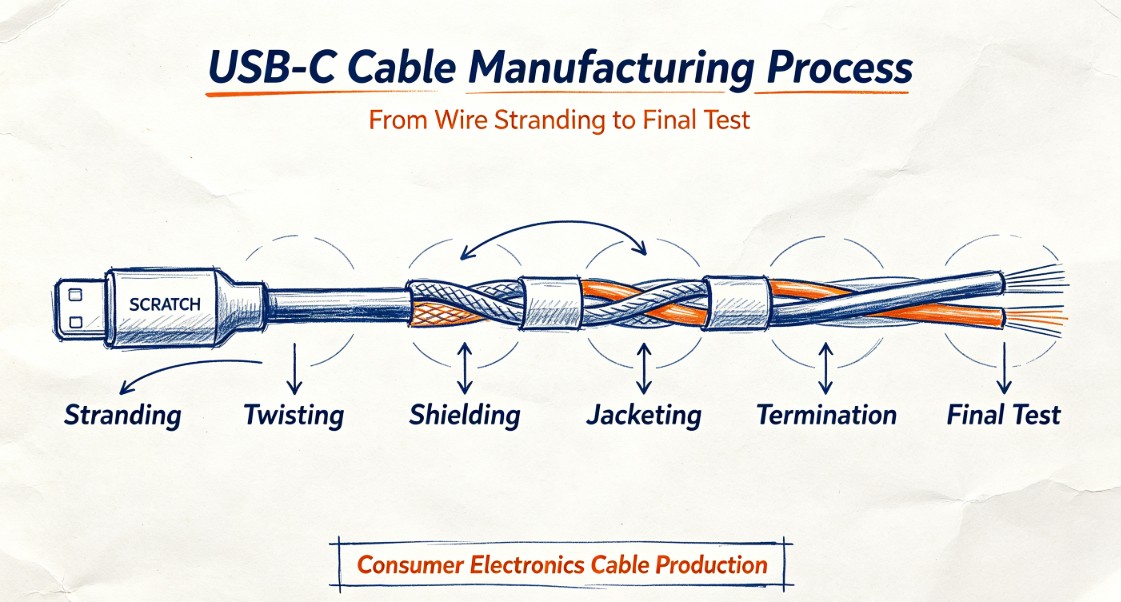
1. IQC (Incoming Quality Control): Raw material inspection for copper conductors, TPE/PVC jacket, USB-C connectors and shielding materials. For shielded cables, incoming inspection also verifies braid coverage and foil integrity — see our article on cable shielding, EMI and EMC for details.
2. IPQC (In-Process Quality Control): Periodic patrol checks during stranding, molding and soldering stages to catch process drift early.
3. FQC (Final Quality Control): Sampling reliability and appearance test after cables are fully assembled.
4. OQC (Outgoing Quality Control): Final random inspection before shipment, double-check packing and specification consistency.
Common Defects Captured in QC
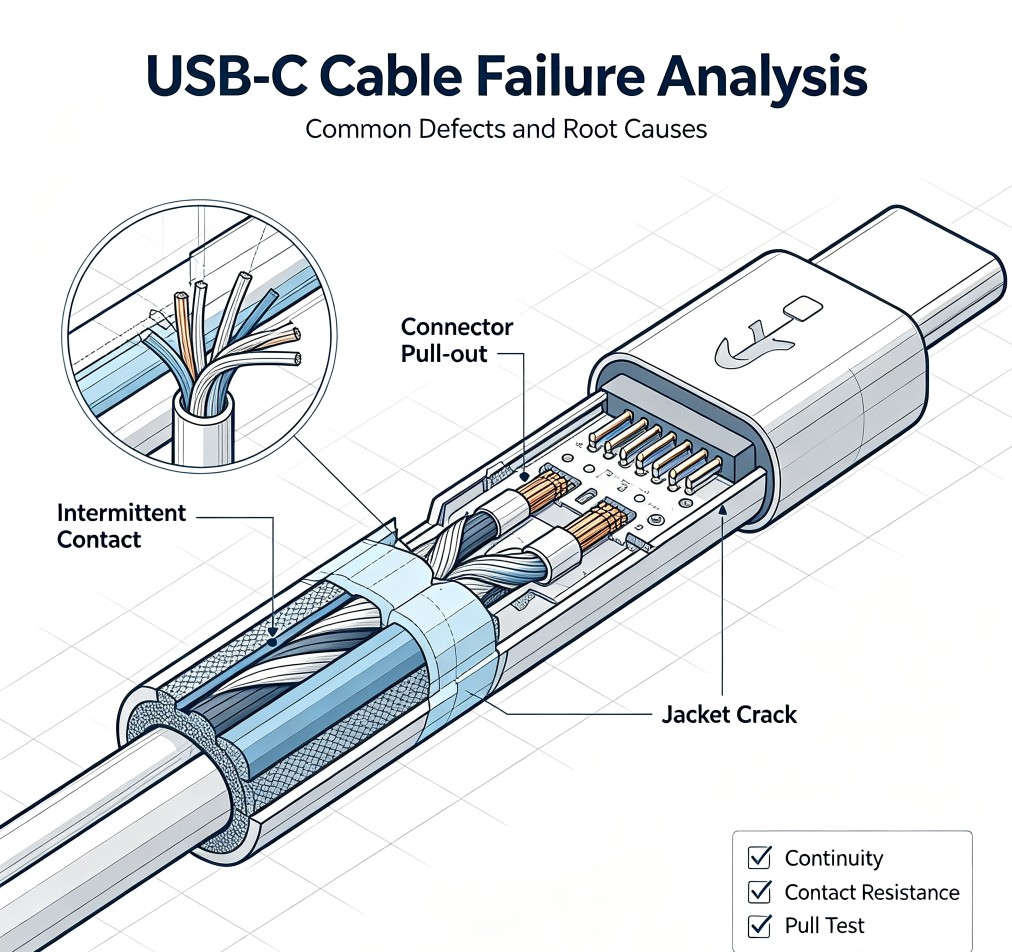
- Intermittent connection caused by poor soldering
- Fast charging downgrade due to high conductor resistance
- Early cable fracture at strain relief
- Insulation leakage risk
- Faded or unclear custom laser marking
Why Rigorous QC Matters for Consumer Electronics Brands
Low-quality cables will push up return rates and damage your brand reputation. A complete QC system ensures consistency across large orders.
If you are sourcing USB-C cables for mobile accessories, read our guide on how to choose USB-C cable for mobile accessories to set your cable specification before launching projects.
LINKSTRONG USB Cable QC Service
LINKSTRONG maintains a complete lab for USB-C data charging cable reliability testing. We support custom test standards according to your product market requirements, together with RoHS, REACH and CE compliance documentation.
We work with consumer electronics brands from prototype validation to mass production. If you are preparing a project inquiry, our custom cable assembly RFQ guide lists all the technical details we need to quote accurately.
If you need custom USB-C cables with strict batch quality control, Contact LINKSTRONG Custom Cable Team to discuss your QC requirements. You may also review our custom USB cable case study for a real consumer electronics project reference.