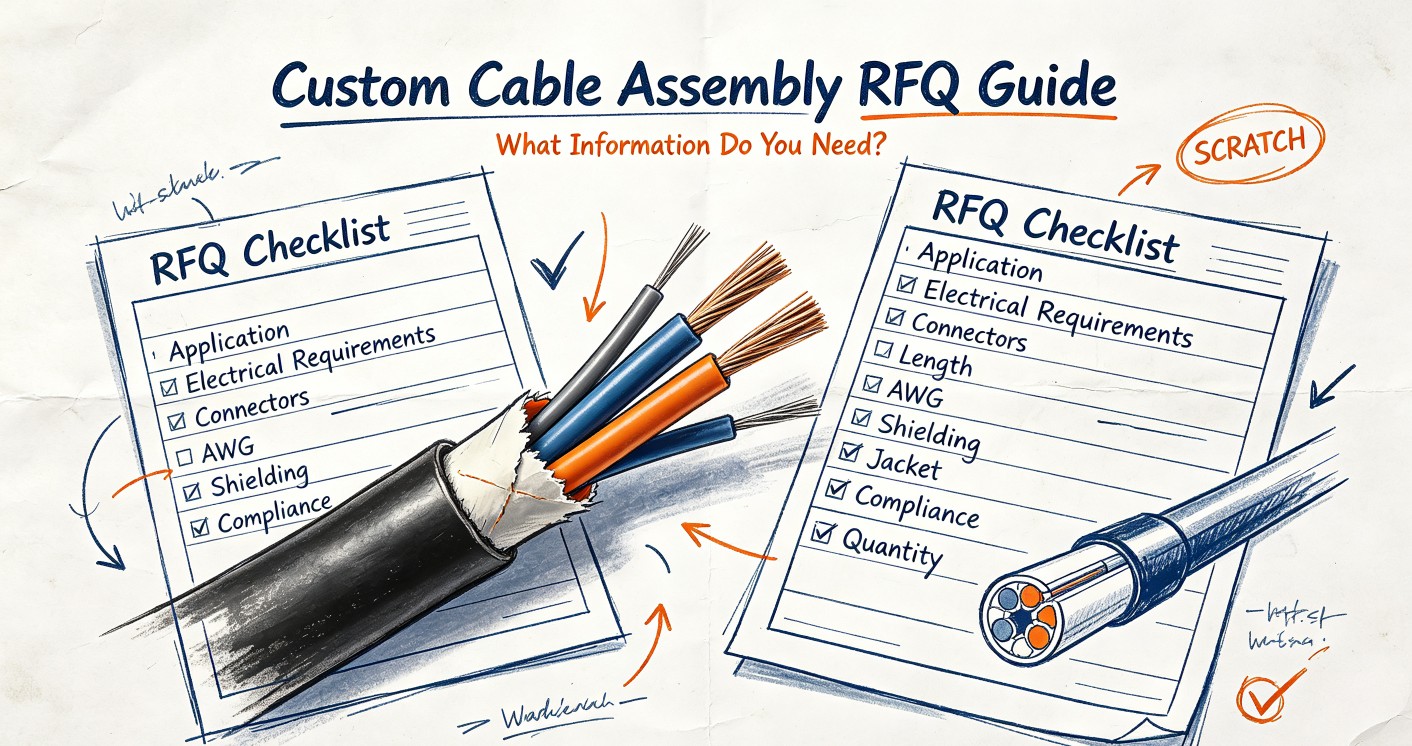
Many projects are delayed because the RFQ only says “custom cable” without defining connectors, wire gauge, length, shielding, or compliance requirements. This guide helps you prepare a complete RFQ.
Basic Project Information
Application
Describe where the cable will be used. Common examples include:
- Industrial control
- Medical equipment
- Test and measurement
- Data acquisition
- Robotics
- Renewable energy
- Automotive
- Consumer electronics
Application matters because it affects temperature, mechanical stress, EMI environment, safety requirements, and expected service life.
Operating Environment
Tell the supplier where the assembly will operate:
- Indoor or outdoor
- Temperature range
- Humidity level
- Exposure to oil, chemicals, or UV light
- Presence of vibration, bending, or abrasion
- EMI or EMC requirements
Electrical Requirements
Voltage and Current Rating
Define the maximum working voltage and continuous current. This helps select wire gauge, insulation thickness, and safety margins.
Data Rate or Protocol
Specify if the cable must support a specific protocol:
- USB 2.0
- USB 3.2
- USB4 / Thunderbolt
- Ethernet
- Serial communication
- High-speed video
- Custom analog or digital signals
Different protocols require different impedance, shielding, and conductor designs.
Impedance
For high-speed applications, specify the required characteristic impedance. Common values include 50Ω, 75Ω, 90Ω, and 100Ω.
Shielding Requirements
Indicate whether shielding is needed and what type:
- No shielding
- Foil only
- Braid only
- Foil plus braid
Mechanical Requirements
Cable Length
Provide the overall length or the acceptable length range. Also specify tolerance if length is critical.
Wire Gauge
AWG is one of the most critical parameters. It affects current capacity, voltage drop, flexibility, and mechanical strength.
Connector Details
List all connectors on both ends, including:
- Manufacturer name
- Part number
- Gender
- Orientation
- Through-hole or surface-mount type
- Waterproof rating, if required
Termination Type
Describe how the cable connects to the device:
- Crimp
- Solder
- IDC (Insulation Displacement Connector)
- Clamp
- Custom connector assembly
Mechanical Durability
Define any mechanical tests or performance expectations:
- Bending cycles
- Flex test
- Pull test
- Vibration test
- Drop test
- Abrasion resistance
Jacket and Material Requirements
Jacket Material
Common options include:
- PVC
- TPE
- PUR
- XLPO
- Halogen-free low-smoke compounds
Jacket Color
Provide the color or color code.
Special Materials
Indicate if you need:
- High-temperature wire
- Low-smoke halogen-free material
- Oil-resistant jacket
- UV-resistant jacket
- Shielding braid with high coverage
Compliance and Standards
List required standards or certifications, such as:
- RoHS
- REACH
- UL
- CSA
- IPC
- ISO
- Medical standards
- Automotive standards
- Fire and smoke standards
Quantity and Schedule
Quantity
Specify annual volume, monthly volume, and initial order quantity. This affects tooling investment and unit price.
Target Price
If you have a target price range, share it early. This helps the supplier propose the most cost-effective design.
Delivery Schedule
Define:
- Sample lead time
- First article lead time
- Mass production lead time
- Delivery date
Documentation Requirements
Technical Drawing
A technical drawing is strongly recommended. It should show:
- Overall assembly shape
- Length and tolerance
- Connector details
- Cable jacket
- Pin assignments
- Bending or mounting details
Bill of Materials
List critical components and preferred manufacturers.
Test Requirements
Define acceptance tests, such as:
- Continuity test
- Insulation resistance test
- Hi-pot test
- Contact resistance test
- Functional test
- Environmental test
Common RFQ Mistakes to Avoid
Mistake 1: Only providing a photo of a similar cable.
A photo helps, but it does not guarantee the same construction or performance.
Mistake 2: Forgetting length tolerance.
Length tolerance can affect installation and interchangeability.
Mistake 3: Ignoring compliance.
Some materials and designs may not meet RoHS, REACH, or industry-specific standards.
Mistake 4: Underestimating mechanical requirements.
A cable that works on the bench may fail in motion, vibration, or bending tests.
Mistake 5: Treating price as the only factor.
Quality, reliability, lead time, and engineering support are also important.
Sample RFQ Checklist
Prepare the following information before contacting your supplier:
- Application and operating environment
- Electrical requirements
- Connector part numbers
- Cable length and tolerance
- Wire gauge
- Shielding type
- Jacket material
- Compliance standards
- Quantity and target price
- Delivery schedule
- Technical drawing or sketch
- Test requirements
How LINKSTRONG Can Help
LINKSTRONG supports custom cable assembly projects from RFQ to production. We review technical requirements, recommend materials and constructions, and provide quotation based on your actual project needs.
The more information you provide, the more accurate our quotation and lead time will be.
Contact LINKSTRONG Custom Cable Team to discuss your custom cable assembly RFQ.