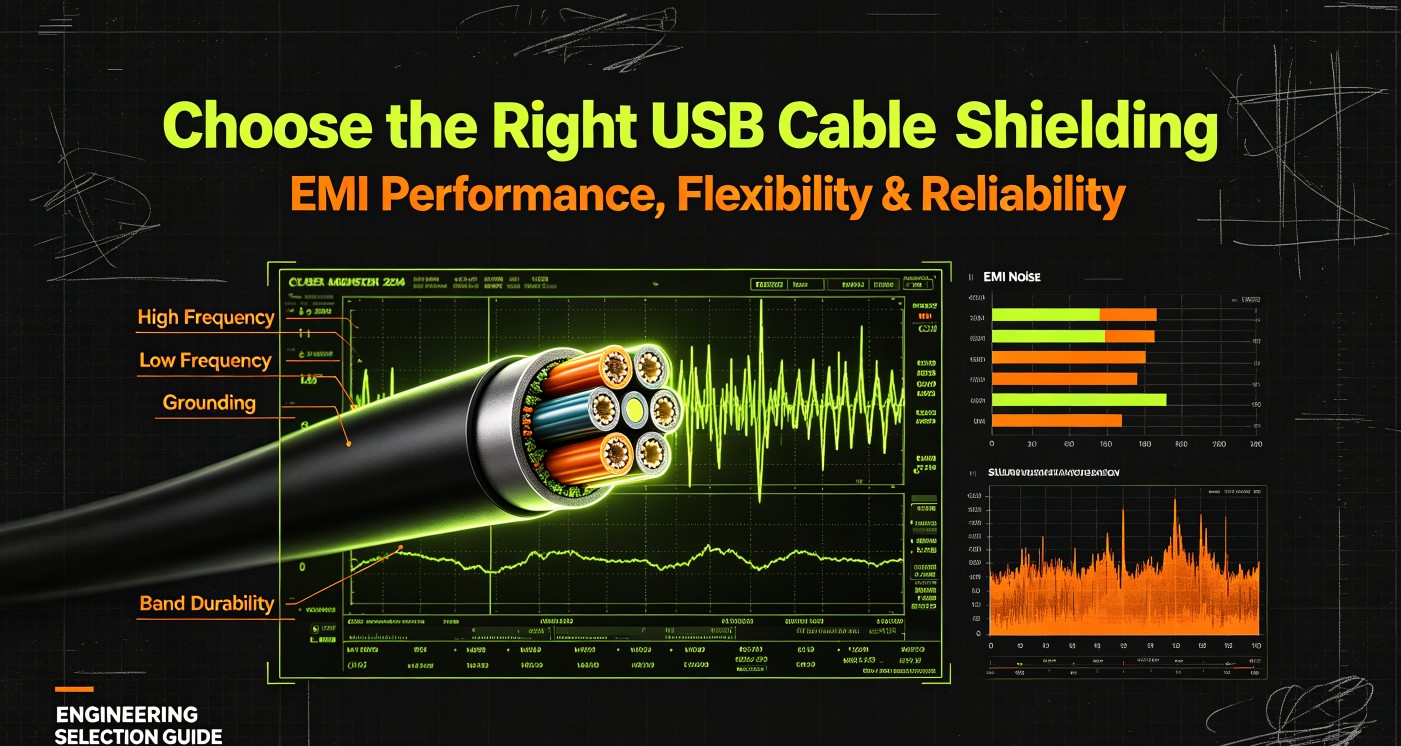
This guide breaks down common USB shielding structures, compares their pros and cons, and provides practical selection guidance for custom USB cable projects.
1. Main Types of USB Cable Shielding
1.1 Foil Shield (Aluminum Mylar Foil)
Aluminum polyester foil wrapped around the internal twisted pairs. It provides 100% coverage against high-frequency electromagnetic interference.
- Advantages: Full coverage, excellent high-frequency EMI suppression, low cost, thin wall construction.
- Disadvantages: Poor flexibility; foil cracks after repeated bending, degrading shielding performance. Drain wire required for grounding.
- Best for: Fixed installation, indoor USB 2.0 / USB3.2 cables with minimal movement.
1.2 Braided Copper Shield
Tinned or bare copper wires woven into a mesh layer surrounding the cable core. Coverage percentage (85% / 90% / 95%) determines shielding effectiveness.
- Advantages: Great flexibility, strong tensile resistance, good low-frequency noise protection, durable for cyclic bending.
- Disadvantages: Does not achieve 100% coverage; higher material cost and larger outer diameter.
- Best for: Consumer USB cables, moving equipment, vibration environments.
1.3 Combined Foil + Braided Shield (Double Shield)
Foil layer wrapped over twisted pairs, plus an outer copper braid layer. This is the highest-performance shielding solution.
- Advantages: Blocks both high-frequency and low-frequency noise, excellent signal integrity for SuperSpeed USB.
- Disadvantages: Largest OD, highest cost, stiffer cable construction.
- Best for: USB3.2 Gen 2x2, industrial automation, medical devices, high-noise factory environments, long cable runs.
1.4 Spiral Shield
Helically wound copper tape. Rare for standard USB; mostly used for very flexible motion cables.
- Advantages: Extreme flexibility for continuous flexing chains.
- Disadvantages: Poor high-frequency shielding, expensive.
- Best for: Motion control, robotic drag chain applications.
2. Shielding Selection Criteria
2.1 USB Data Speed Requirement
- USB 2.0 (480Mbps): Single foil or low-coverage braid is usually sufficient. EMI risk is relatively low.
- USB 3.2 Gen1 / Gen2 (5Gbps /10Gbps): Must use foil shielding for the high-speed differential pairs. Double shield is recommended for long length (>2m).
- USB4 / Thunderbolt: Strict impedance and crosstalk requirements. Double shielding is mandatory. Read our guide about Thunderbolt vs USB-C differences.
2.2 Operating Environment
- Office / consumer: Single braided shield works well.
- Factory floor, motors, power inverters: Strong electromagnetic noise, choose double shield.
- Repeated bending / flexing machinery: Prioritize braid over pure foil. Foil will crack after thousands of bends.
- Outdoor / harsh chemical exposure: Combine shielding with suitable jacket material. See our comparison of PVC, TPE, PUR and XLPO.
2.3 Cable Length
Longer cables amplify signal attenuation and noise pickup.
- Under 1m: Single shield is often acceptable for USB3.2.
- 1m ~3m: Double shield recommended for SuperSpeed.
- Over 3m: Active signal booster IC is usually required alongside high-performance shielding.
2.4 Grounding Design
Shielding only works when properly grounded at the connector termination.
- Single-end grounding: Ground shield only at host side. Avoid ground loop noise in industrial systems.
- Double-end grounding: Ground both ends, suitable for high-frequency noise but may introduce ground loop currents.
The termination process is a critical step in our USB-C cable manufacturing process.
3. Common Mistakes in Shielding Design
1. Choosing pure foil shield for a repeatedly bent cable. Foil cracking leads to intermittent EMI failure in field use.
2. Using low braid coverage (<80%) for high-speed USB3.2. Gaps allow high-frequency interference to leak through.
3. Poor shield termination at the plug. Even a good shield becomes useless if grounding is broken during molding.
4. Over-specifying shielding. Double shield adds cost and diameter unnecessarily for simple USB2.0 static applications.
4. LINKSTRONG Custom Shielding Service
When you request a custom USB cable, our engineering team will match the shielding structure according to your speed, length, environment and budget.
- Impedance and crosstalk simulation at design stage
- EMI pre-test during prototype phase
- Full electrical and mechanical batch QC. Refer to our USB-C cable quality control guide.
We have delivered many shielding-critical projects. Check our custom USB data charging cable case study.
If you are unsure which shielding type fits your project, contact LINKSTRONG custom cable team to share your specification. Before issuing RFQ, review our custom cable assembly RFQ guide.