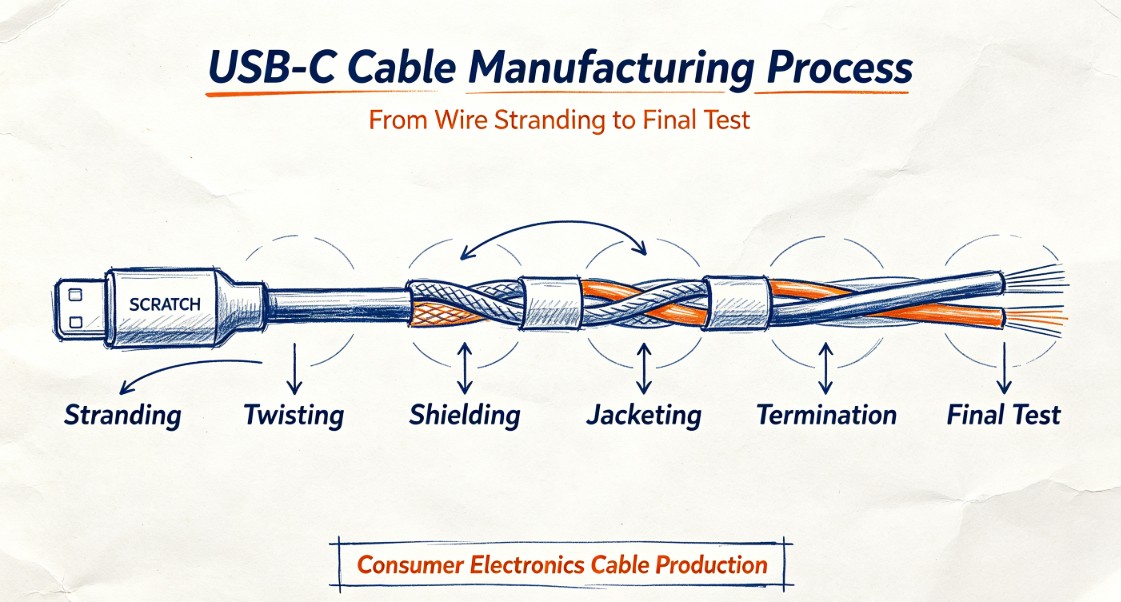
For consumer electronics brands, understanding the USB-C cable manufacturing process helps you evaluate suppliers, control quality, and avoid field failures.
1. Wire Stranding
The process begins with copper wires. Individual copper strands are twisted together to form conductors.
Stranding improves:
- Flexibility
- Tensile strength
- Current carrying capacity
- Resistance to metal fatigue
The number of strands and the overall conductor size are selected based on current requirements and bending durability.
2. Insulation
Each conductor is covered with insulation material. Insulation prevents short circuits and separates different electrical paths.
Common insulation materials include:
- PVC
- PE
- XLPE
For high-speed data cables, insulation also helps control characteristic impedance and reduce crosstalk.
3. Twisting
Different conductors are twisted into pairs or groups. Twisting helps reduce electromagnetic interference between wires.
Twist pitch must be carefully controlled. If the twist is too loose or too uneven, data performance and signal integrity can suffer.
4. Shielding
Many USB-C data charging cables include shielding to reduce interference.
Shielding options:
- Aluminum foil
- Braid shield
- Foil plus braid combination
Shielding is especially important for high-speed data cables and cables used in electrically noisy environments.
5. Jacketing
After the internal structure is ready, the cable is coated with an outer jacket.
The jacket provides:
- Mechanical protection
- Abrasion resistance
- Flexibility
- Environmental protection
- Visual identity
Common jacket materials for consumer USB-C cables include PVC and TPE. TPE is widely used for premium mobile accessories because of its soft touch and good flexibility.
6. Cable Cutting and Stripping
Once the cable is manufactured, it is cut to length. Then the outer jacket, shielding, and insulation are stripped carefully.
Poor stripping can damage conductors or cause internal defects. This step requires precision to ensure reliable termination.
7. Connector Preparation
The USB-C connector is prepared for assembly. Pins are organized, and some connectors require pre-soldering or crimping.
Connector quality is critical because the connector area is one of the most common failure points in USB-C cables.
8. Termination
Termination connects the internal wires to the USB-C connector. The most common method is soldering.
Good termination ensures:
- Low contact resistance
- Stable electrical connection
- Strong mechanical bonding
- Reliable data and power transmission
9. Strain Relief Assembly
The connector area must be reinforced. Strain relief absorbs stress when the cable is bent or pulled.
Strain relief can include:
- Inner reinforcement
- Glue or epoxy
- Molded jacket transition
- Connector crimp structure
This step is essential for bending durability.
10. Molding
Many consumer USB-C cables are over-molded at the connector end. Molding creates a strong bond between the cable and connector.
Molding also improves:
- Appearance
- Mechanical strength
- Strain relief
- Brand identity
11. Assembly and Housing
In some designs, the connector shell or housing is assembled after molding. This step protects the internal termination and completes the connector structure.
12. Testing
Testing is performed throughout the process and at the final stage.
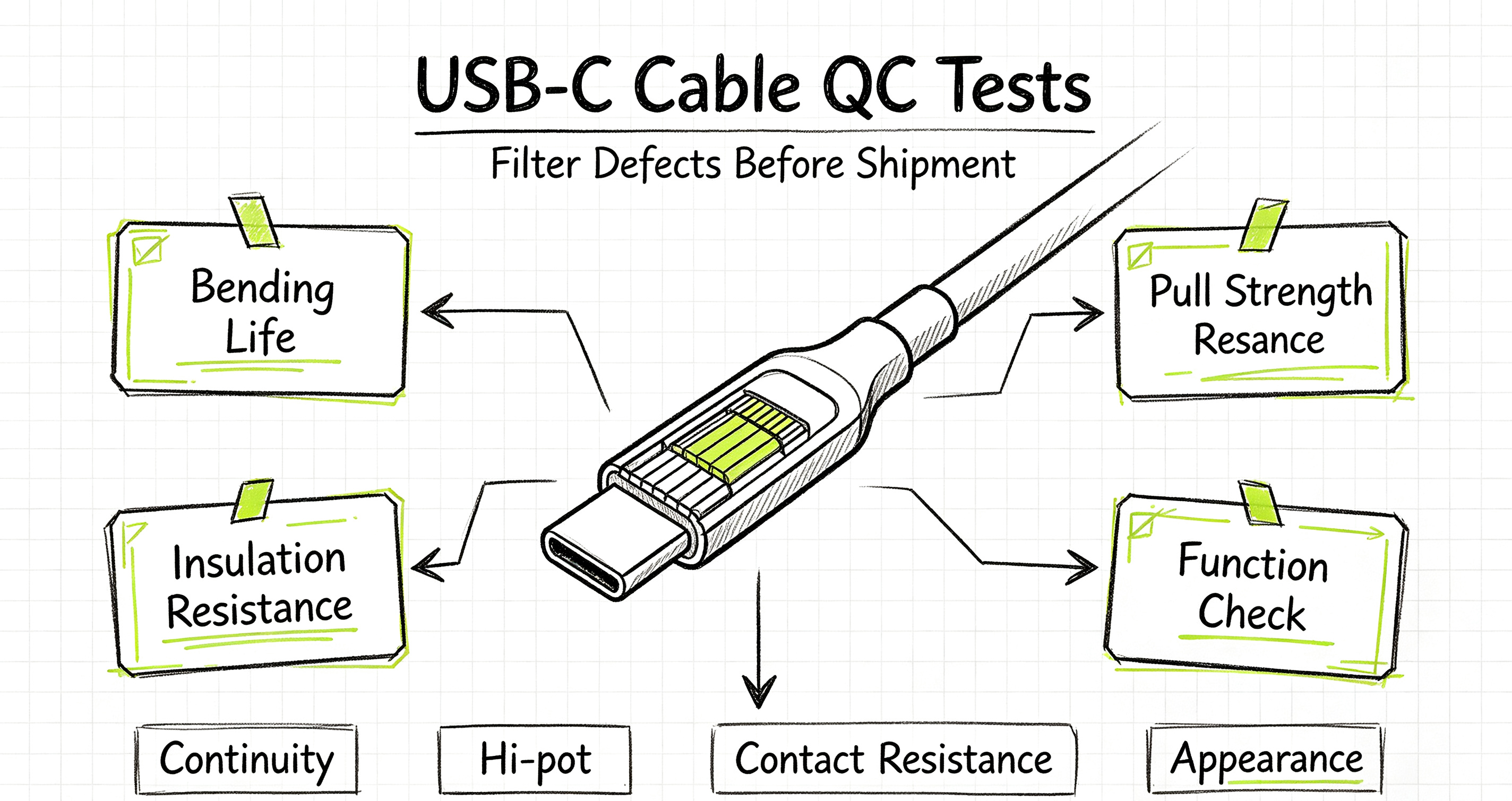
Common USB-C cable tests:
- Continuity test
- Open/short test
- Contact resistance test
- Insulation resistance test
- Hi-pot test
- Function test
- Bending test
- Appearance inspection
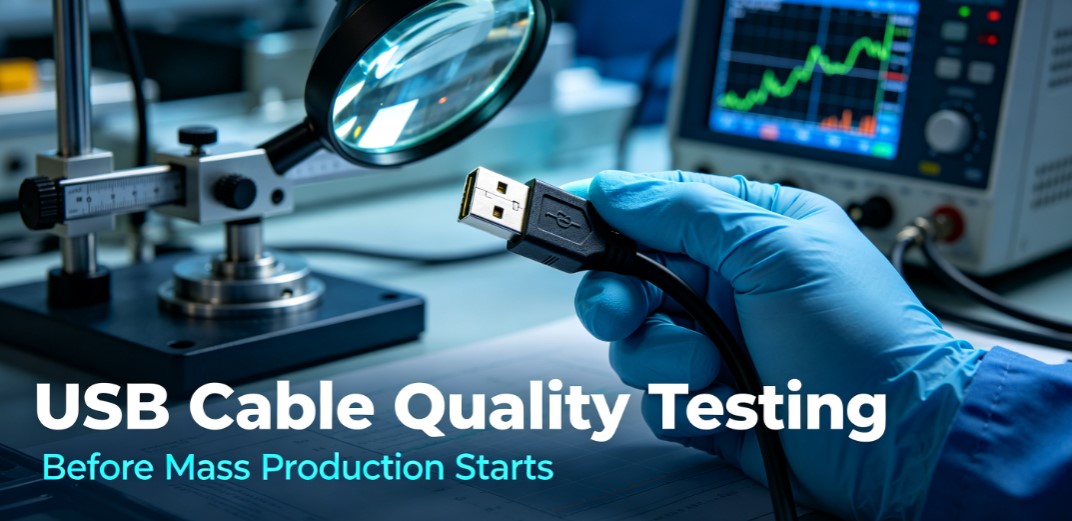
Testing helps identify defects before the cable reaches the customer.
Key Quality Control Points
Conductor Quality
Pure copper conductors with consistent stranding ensure stable current carrying capacity.
Soldering Quality
Cold solder joints, loose wires, or insufficient solder can cause intermittent connections.
Molding Quality
Poor molding can cause loose connectors, cracks, or weak strain relief.
Shielding Connection
For shielded cables, the shield must be properly connected to maintain EMC performance.
Final Electrical Test
Every cable should be tested for continuity, short circuits, and basic electrical function.
Why Process Control Matters
USB-C cable manufacturing seems simple, but small process variations can cause big reliability problems.
Common failures caused by poor manufacturing:
- Intermittent charging
- Data transfer failure
- High contact resistance
- Broken conductors
- Poor bending life
- Early connector failure
A controlled production process reduces these risks and improves consistency.
LINKSTRONG USB-C Cable Manufacturing Capability
LINKSTRONG manufactures custom USB-C data charging cables for consumer electronics brands. Our process includes conductor preparation, stranding, twisting, shielding, jacketing, termination, molding, and final testing.
We support custom requirements for:
- USB-C to USB-C cables
- USB-A to USB-C cables
- Fast charging cables
- Data sync cables
- Premium mobile accessory cables
- Custom color and branding
If you want to develop a reliable USB-C cable for your consumer electronics product, Contact LINKSTRONG Custom Cable Team to discuss your project.