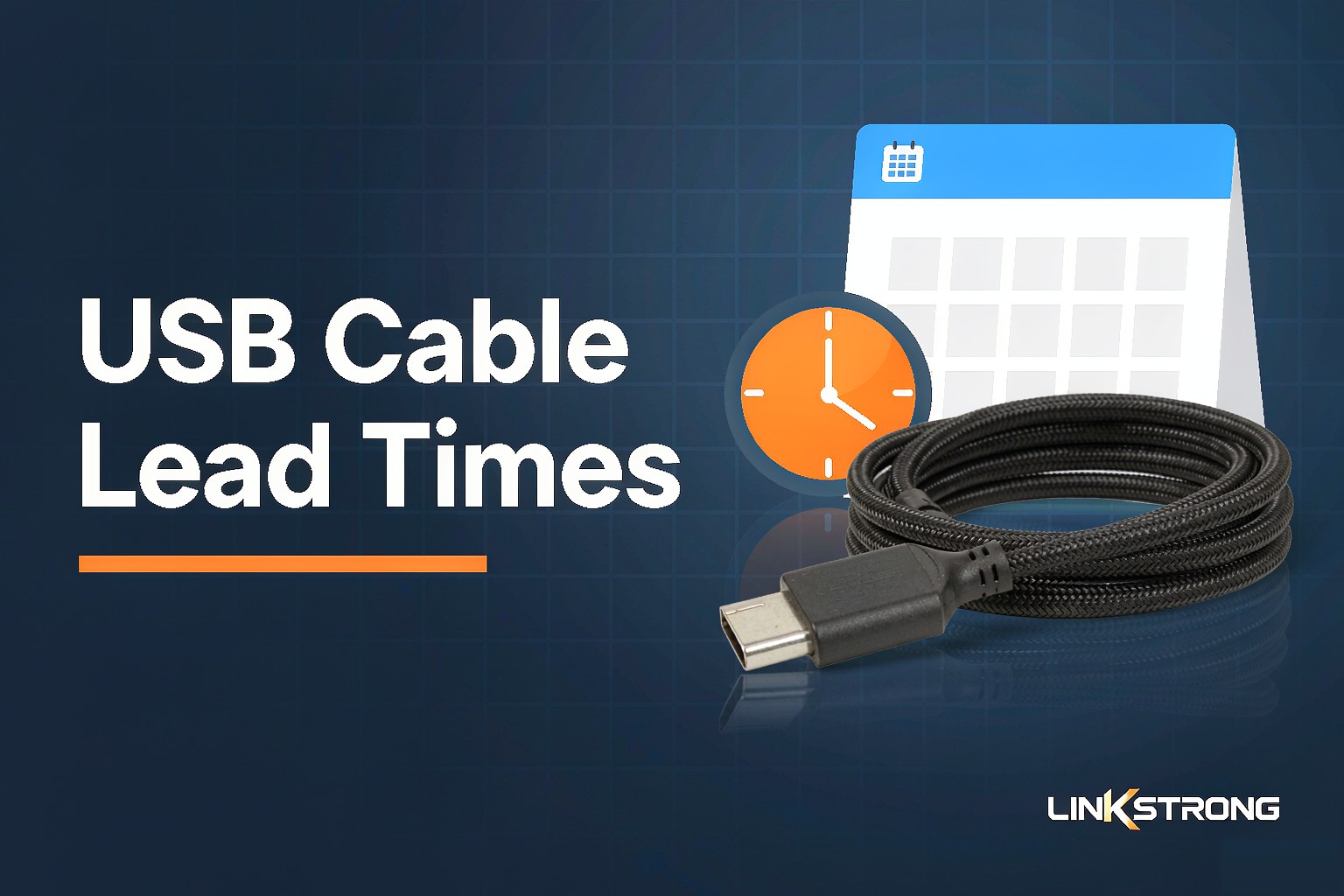
This guide breaks down where the days go, what quietly adds two weeks, and what a brand can realistically do to compress the timeline.
The Three Clocks Behind Every Lead Time
Tooling (7-20 days, only when needed). If your cable uses an existing mold for the connector shell and strain relief, this clock reads zero. If it needs a new housing shape, a custom logo mold or a braided-jacket collet change, add 7-10 days for a simple mold and up to 20 days for a two-piece shell with a metal housing. Tooling time is also where approvals matter most: every revision to the 3D drawing restarts part of the clock.
Production (15-30 days). For a 5,000-20,000 piece order with approved samples, production is predictable: wire cutting and stripping, soldering, assembly, molding, testing and packaging. Two things stretch it. First, E-marker chips for USB-C cables above 3A are sourced from chip distributors, and lead times there fluctuate with global demand - a factory holding chip stock is a factory that ships on time. Second, certification samples: if your listing claims UL 9990 or the cable is MFi-licensed, plan for pre-production samples being pulled aside for lab submission.
Freight (5-35 days). Ocean freight from Shenzhen to Los Angeles runs roughly 15-20 days on the water plus port clearance and inland transit - call it 25-35 days door-to-door in a normal season, longer in the pre-holiday peak. Air freight is 5-8 days and costs several times more per kilogram, which is why it makes sense for launch quantities and replenishment, not for full POs.
What Quietly Adds Two Weeks
- Late artwork. Packaging dielines, logo files and Pantone numbers that arrive after mass production starts. Artwork is the single most common cause of slipped ship dates - not the cable itself.
- Sample revision loops. Each round of courier samples costs 5-7 days. Two rounds are normal; four rounds mean the specification was never frozen. Our RFQ guide lists the information that removes most revision rounds up front.
- Certification tests done in sequence instead of in parallel. UL 9990 testing on finished goods can run while production of the next batch starts - if the sample plan was agreed before mass production.
- Chinese public holidays. Chinese New Year (late January-February) and National Day week (early October) close factories for 1-2 weeks. Orders placed in late September compete with pre-holiday rush capacity; this year, buyers who started in August had their goods on the water before the shutdown.
- Q4 freight congestion. From mid-October, ocean space tightens and rollings (missed sailings) become common. Add a buffer week to any ocean quote between October and December.
A Realistic Timeline, Week by Week
Week 0: PO placed, specification frozen, artwork and dielines delivered. Week 1-2: tooling (if any) and golden sample approval - one round, not three. Week 2-6: mass production with in-line QC. Week 5-6: booking and export documents; certification samples dispatched in parallel if needed. Week 6-10: ocean transit and import clearance, or Week 6-7 by air. A brand that wants goods on an Amazon shelf by the last week of November needs to place the PO by the first week of October at the latest.
How to Compress Without Gambling on Quality
Freeze the spec before the PO, not after. Most delay lives in revisions, not production. A complete spec - conductor gauge, jacket material, length, color, housing finish, E-marker rating, packaging - is what turns a 45-day project into a 30-day one. Our MOQ and ordering guide covers what to lock down.
Split the shipment. Produce 20-30% first, air-freight it to cover the launch window, and let the balance move by ocean. The air premium on a fraction of the order is usually cheaper than losing two selling weeks.
Ask the factory what is in stock. Connector shells, braided jackets and E-marker chips in standard colors are often stocked. Choosing a shell that is already on the shelf instead of a custom-machined one can remove the entire tooling clock.
Pay for schedule reliability, not promises. A factory that gives a longer, honest date and holds it is worth more than one that quotes 25 days and ships on day 40. Ask how many active orders are on the line during your production window, and whether certification samples run in parallel.
The Bottom Line
For a standard custom USB cable with existing tooling, 25-35 days from PO to port is a fair expectation, and 40-55 days door-to-door by ocean. Custom tooling, new certifications or holiday congestion each add their slice. The brands that ship on time are not the ones that squeeze factories hardest - they are the ones that arrive with a frozen specification and a calendar that respects the three clocks.
If you are planning an order, send us your target date and specification through our OEM sourcing checklist or contact our team directly - we will map the timeline backward from your launch and tell you honestly whether ocean freight still works.