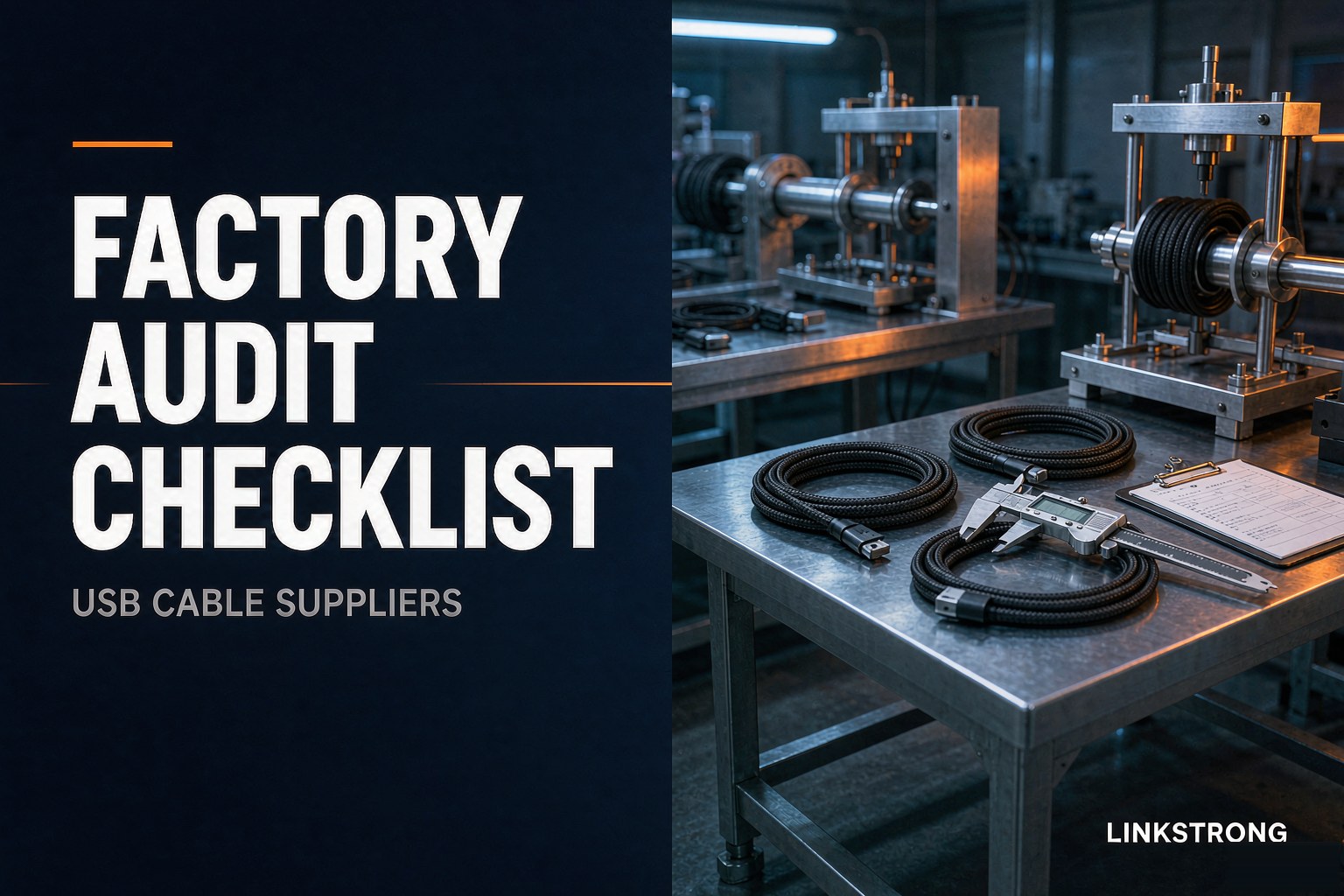
This is the checklist we would use if we were buying from ourselves: what to ask for, what to walk on the floor and look at, and which findings should end the conversation.
The documents to request before you book a flight
Ask for these five files first. Suppliers who hesitate on any of them are usually hesitating for a reason.
- Business licence and factory lease naming the same legal entity and the same address you plan to visit.
- Latest ISO 9001 certificate with the scope in English, plus the audit body and expiry date. A certificate that covers "sales office" is not a certificate for the plant.
- Test equipment list with model numbers for the hipot tester, DC resistance meter, pull-force gauge and bend-test rig.
- Two customer references in the same product category, ideally US or EU accounts.
- A written sub-contracting statement listing which processes leave the building.
If the test equipment list is honest, it will name a few older machines. A list where everything was purchased in the same year is often a list written for the audit.
Walk the floor: five places problems hide
A cable plant is a short walk: wire storage, cutting and stripping, soldering or IDC, molding or assembly, then test and pack. Spend your time in the first three.
Incoming wire storage. Look for desiccant, dated tags and a spool log. Copper that sits in humid air for a year before extrusion oxidizes, and oxidized conductor is a resistance problem you will only see in field returns.
Solder and termination. Ask to see the pull-force record for the last three lots, not the certificate on the wall. Sample data should show a distribution with a lowest value, not a single passing number.
Molding compound. One hopper, one label, one batch number per shift is normal. Four unlabelled bags beside the machine means the jacket hardness on your units is whatever was open that day.
Test station. Watch one unit go through hipot and continuity. If the operator tests five units at once by clamping a jig, the test is a formality.
Quarantine area. Every factory has defects. The question is whether they are labelled, dated and separated, or pushed into a corner to be reworked later.
What the audit is really scoring
Score each area on evidence, not on answers. A simple 1–5 scale per area, weighted by failure cost, works better than a 200-point checklist nobody reads.
| Area | Weight | What "5" looks like |
|---|---|---|
| Conductor control | 25% | Spool log, mill certificate per lot, resistance spot-check |
| Termination quality | 25% | Pull-force data per lot, X-ray or cross-section on request |
| Test coverage | 20% | 100% hipot and continuity, sampled bend and insertion |
| Capacity headroom | 15% | Named free lines for your peak month |
| Traceability | 15% | Lot code on carton traceable to wire batch and shift |
Anything scoring below 3 on conductor control or termination quality is a price conversation, not a quality conversation.
The findings that should stop the order
Some issues are fixable with a corrective action plan. Others are structural.
- No lot traceability on cartons. If a failure cannot be traced to a wire batch, every recall is 100% of the shipment.
- Braiding sub-contracted during peak. Your bend-test performance then depends on a shop you have never audited.
- Test records typed the night before the visit. Check the printer timestamps.
- No engineering contact. A factory whose only English-speaking contact is a salesperson cannot answer a spec change without a relay.
Factory audits are also where lead-time promises get tested. If the plan shows 25 days with a full order book, ask which orders move when yours arrives, and see how that answer lines up with our guide to USB cable lead times. Capacity claims and calendar claims should agree.
Pair the audit with the paperwork
A factory audit does not replace a supplier qualification. The commercial side has to hold up too: who signs the quality agreement, who owns the tooling, and what happens to your deposit if the shipment fails inspection. Our checklist for selecting a custom USB cable manufacturer covers the contract terms that audits never touch, and the article on payment terms with Chinese suppliers explains how to tie the balance to an inspection result instead of a ship date.
Budget the audit properly. Two days on site, one interpreter, and a written report with photos costs less than a single chargeback cycle, and it gives you a baseline to audit against next year. Factories behave differently when they know the same eight areas will be checked again.
If you are qualifying a new source for a 2027 program and want the plant walk to include a line trial on your own housing and jacket colour, send the specification to our team through the contact page. We will tell you what we can show you on the floor before you book the flight.