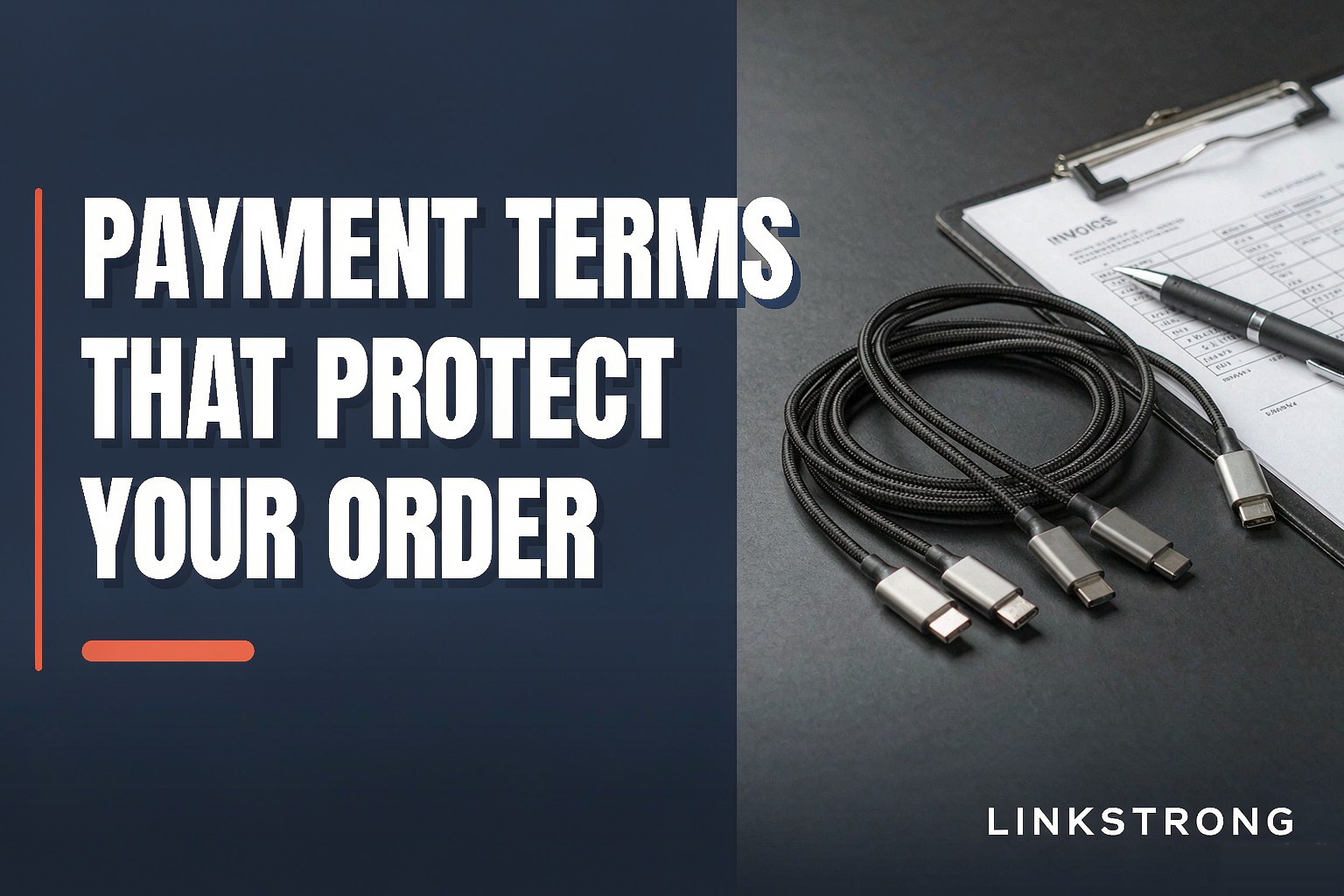
What a Deposit Is Really Paying For
A cable is a stack of purchased parts, and almost all of them are bought before production starts:
- Copper conductor is the largest single material line. A 240W USB-C cable uses heavier gauge copper than a 60W cable, and copper is priced daily.
- Connectors and E-marker chips are often the longest-lead components. A factory placing a chip order in week one is committing cash in week one.
- Jacket compound, braid and shielding are bought by the drum, not by the piece.
- Labor and line time are booked against a schedule, which means the factory turns away other work to hold your slot.
That is why 30% up front is the industry default rather than a trick. The 30% covers materials; the 70% covers labor, overhead and margin, which is why factories want it before the container leaves.
The Four Structures You Will Be Offered
| Structure | Typical split | Who carries the risk | Best used for |
|---|---|---|---|
| T/T deposit and balance | 30% deposit, 70% before shipment | Buyer carries most of it | Repeat orders with a supplier you have shipped with |
| Letter of credit at sight | 100% on documents | Shared, bank-mediated | Orders above roughly USD 50,000 |
| Escrow or platform trade assurance | Funds released on milestones | Platform holds the money | First orders with a new supplier |
| Open account, net 30 to 60 | 0% deposit | Supplier carries it | Established accounts after several clean shipments |
Most brand buyers end up on T/T because it is cheap and fast, and then discover the weakness: the 70% is due before they have seen the goods. If that describes your position, the fix is not a new payment structure but better milestones.
Keep Tooling Out of the Deposit
Tooling is where first orders go wrong, because it is paid early and delivered late. Treat it as a separate invoice with its own terms:
- Pay tooling in two parts, roughly half on order and half on sample approval, not on delivery of the tool.
- State in writing that the tool is owned by the buyer and must be handed over or scrapped on request.
- Ask for the amortization schedule if the supplier offers to spread tooling cost into unit price, and check what happens if you move the tool to a second factory.
A supplier who refuses to separate tooling from production is telling you the tool is financing something else.
Milestones Worth Paying Against
Instead of paying a percentage on a calendar date, tie each installment to a document or a physical sample:
- Sample sign-off. The gold sample is the reference for the whole order; pay nothing further until it is approved in writing.
- Pre-production sample from the actual line. A bench sample and a line sample are different objects. Our guide to testing cable quality before mass production covers what to measure at this stage.
- In-process inspection at 30% completion. Cheaper to fix a defect pattern here than after packing.
- Pre-shipment inspection with a written report. AQL sampling on function, appearance, labeling and packaging.
- Bill of lading copy or telex release. The balance should buy you the document that controls the cargo, not a promise that it exists.
Red Flags in a Payment Request
- 100% upfront on a first order. Normal only for sample quantities.
- Bank account name that does not match the company name. Legitimate factories invoice under their registered entity.
- Deposit percentage rising between quotation and PI with no change in specification.
- Refusal of third-party inspection at your cost.
- Pressure to pay through a personal account or messaging app. This removes every dispute mechanism you have.
Contract Clauses That Do the Real Work
Payment terms are only as strong as the clauses around them. Four lines in a purchase contract prevent most disputes: a delivery date with a defined penalty, a quality holdback of 5% to 10% released after receipt, tooling and artwork ownership, and a written change-control rule so that spec edits reopen the price and the date instead of quietly slipping both.
None of this is exotic. It is simply the difference between paying a supplier and financing one. If you are still shaping the commercial side of a first order, our MOQ guide for brand buyers explains how volume tiers interact with deposits, the supplier selection checklist covers what to verify in parallel, and the RFQ guide shows how to put all of this into one document before quoting starts.
Building a first cable program and want the commercial terms reviewed before you sign? Send us your draft PI and we will mark up the parts that usually cause trouble.