This article explains what CCA is, why it fails specifically in charging cables, where it is defensible, and how to detect it without sending samples to a lab.
What CCA actually is
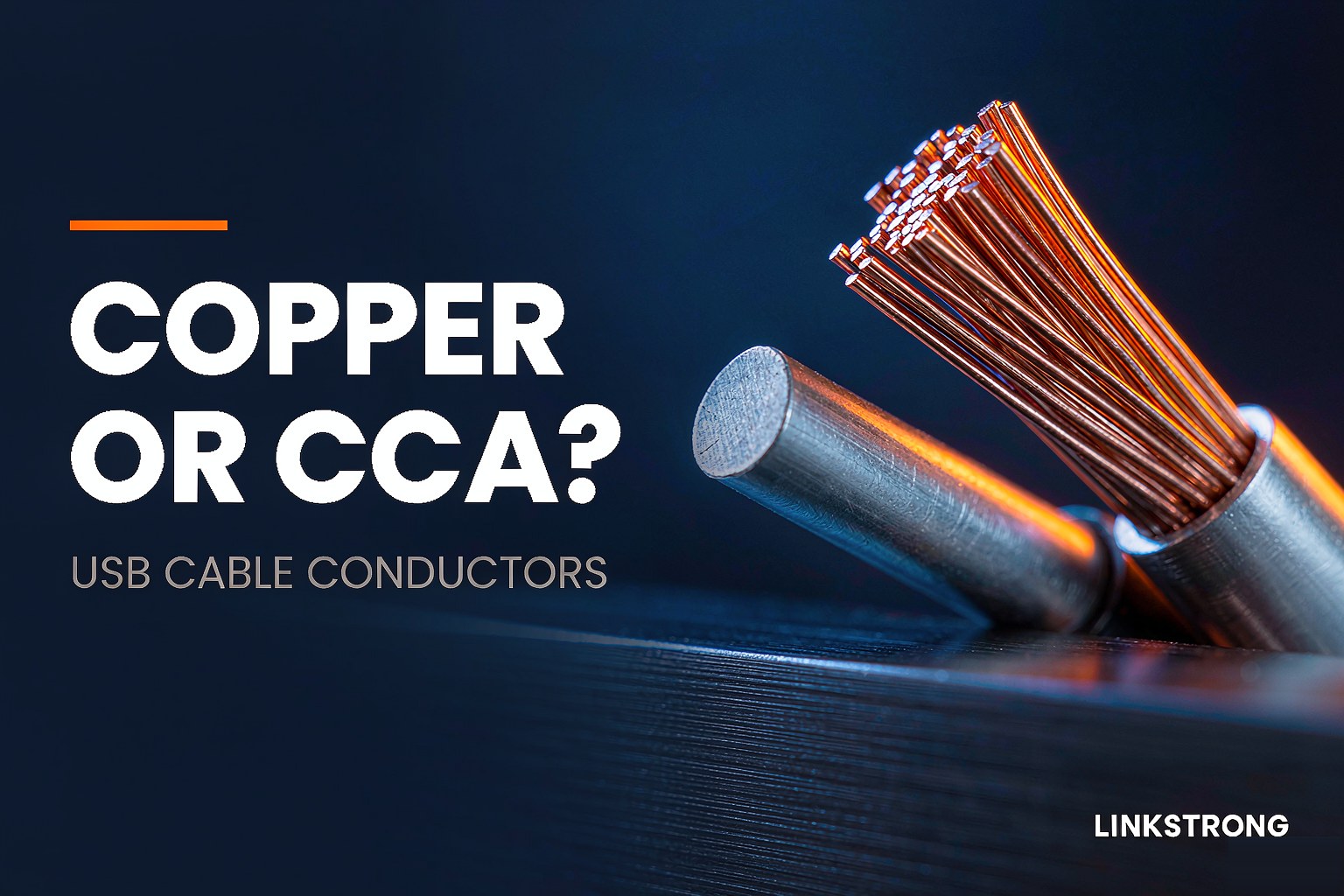
Copper-clad aluminium is an aluminium core with a thin copper skin, typically 10 to 15 percent of the cross-section by weight. It exists for coaxial and ethernet applications where the signal travels in the skin at high frequency, so the aluminium core does very little work. The copper is there to be soldered and to carry the surface current.
In a DC charging cable, current uses the whole cross-section. Aluminium has roughly 1.6 times the resistivity of copper, so a CCA conductor of the same gauge has meaningfully higher resistance, and the copper skin is far too thin to compensate.
Why it fails in charging cables
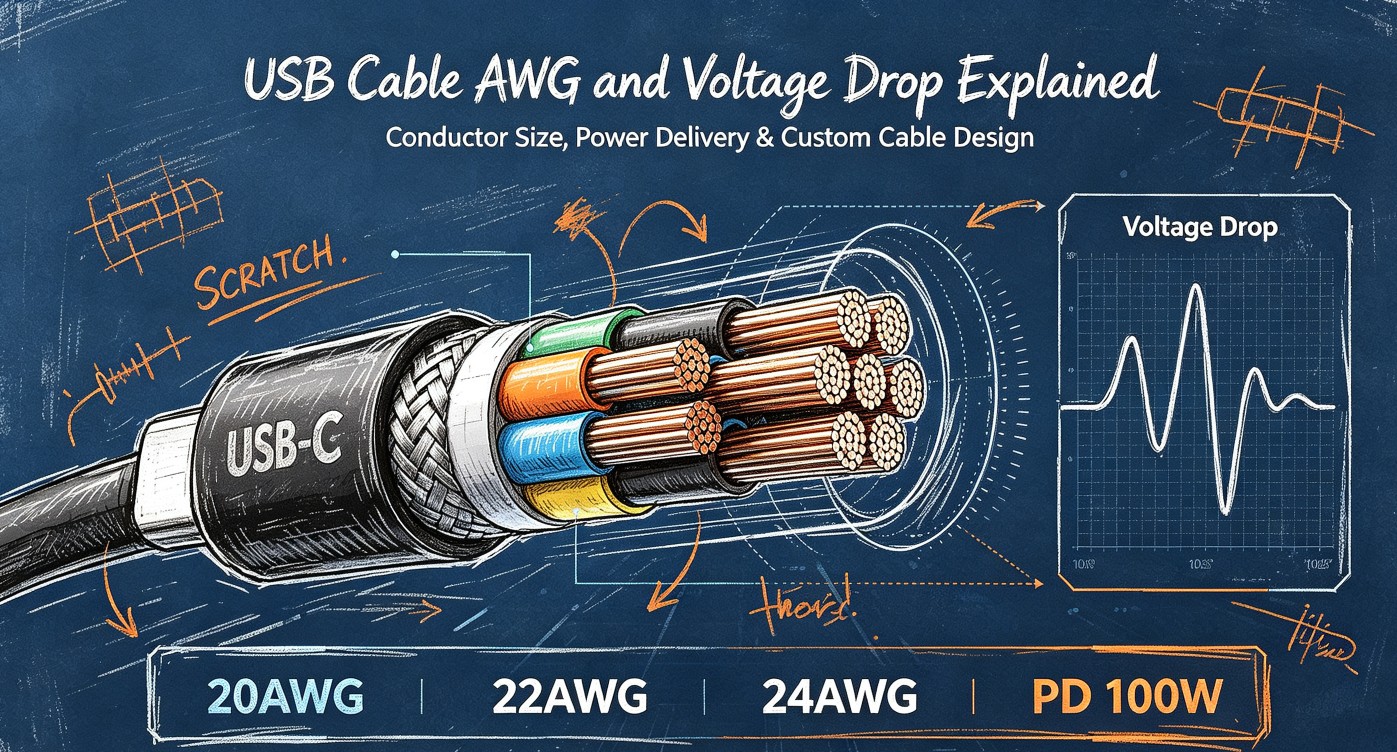
Resistance converts voltage into heat. At 3A the effect is measurable but survivable. At 5A, which is where 100W and 240W USB-C Power Delivery cables operate, it becomes the dominant loss.
- Voltage drop. A 1m 22AWG CCA cable carrying 5A drops well over 0.6V on the return and supply pair combined. Devices with tight input tolerance derate charging speed or refuse the highest PD profile.
- Heat. The loss appears as heat in the conductor and jacket. In a 20AWG assembly that heat sits close to the TPE or PVC surface, and a cable that passes a 25°C hipot test cold can run warm enough to fail a temperature-rise check under load.
- Strand breakage. Aluminium work-hardens and fatigues faster than copper. In a cable that sees daily coiling, CCA strands break first at the strain relief, which shows up as intermittent charging rather than a clean failure.
- Solder joints. Even with a copper skin, aluminium wicks heat away and forms brittle intermetallics at the joint if the process is not tuned for it.
The failure mode matters commercially. A cable that stops working is a warranty claim. A cable that charges slowly at 40W on a 100W port is a one-star review that says the cable is "fake", and the customer rarely blames the conductor.
Where CCA is defensible
CCA is not automatically dishonest. It is a legitimate material for short, low-current, signal-only assemblies, and for cables where flexibility and cost dominate. The problem is when it is substituted silently into a power path.
A defensible use looks like a 0.3m charging-only cable for a low-draw accessory, clearly labelled, priced accordingly, and not sold as a 100W cable. Anything that claims USB PD above 60W, anything marketed for laptops, and anything with an e-marker should be copper.
Detecting CCA without a lab
You can screen a shipment in ten minutes with hand tools.
- Scrape test. Cut a strand and scrape the end with a knife. Copper is copper all the way through. CCA shows a silver core under a thin copper skin.
- Weight check. Aluminium is about 30 percent the density of copper. Weigh 100m of the same gauge against a known-good reference; CCA will be visibly lighter.
- Resistance check. A four-wire milliohm meter on a 1m loop is the definitive field test. Compare against the table below rather than a single sample.
- Price sanity. If a quotation for 22AWG/2C plus 28AWG/3C lands below the copper content cost of the assembly, the conductor is not copper. Copper content is the floor of any honest quote.
| Conductor | 1m loop resistance, 22AWG 2C | Expected 5A drop |
|---|---|---|
| Bare copper | about 0.11 ohm | under 0.6V |
| CCA | about 0.18 ohm | over 0.85V |
Numbers above assume 20°C and nominal stranding; treat them as a screening threshold, not a specification.
Writing copper into the purchase order
Specify the conductor, not just the gauge. "22AWG" describes a diameter, and two suppliers can meet it with different metals.
State bare stranded copper, the strand count, the resistance limit per 100m, and the acceptance test. Reference the construction you already qualified: our guide to wire gauge and copper thickness shows the strand builds that meet 60W, 100W and 240W, and the AWG and voltage drop guide gives the calculation to set your own limits.
Then tie it to certification. A UL 9990 listing is granted to a specific construction, and a conductor substitution is a construction change, not a cost-down. If a supplier offers CCA on a certified assembly, the certificate does not cover what they are shipping.
For 100W and 240W assemblies there is a second layer: the e-marker reports the cable's current capability to the charger. A cable that tells the charger it can carry 5A while running CCA conductor is a compliance problem and a thermal one at the same time.
What to do this quarter
Pull three SKUs from your current range, cut one unit each, and run the scrape test. If any of them is CCA and sold above 60W, you have a warranty exposure you can quantify before the holiday season rather than after it. Then put the resistance limit into the next purchase order, so the specification survives the next quotation round.
If you want a second opinion on a conductor spec, or a cross-section photo of the build we propose for your cable, send the drawing to our engineering team through the contact page and we will return the strand count and resistance figures in writing.