This practical checklist walks you through core criteria to evaluate custom USB-A and USB-C cables before confirming samples and mass production.
Understand Your Actual Project Requirements
Before requesting quotations, clarify your core usage scenarios, otherwise you may receive mismatched samples.
Charging-Only or Charging + Data Sync?
Charging-only cable
Reduced internal pin count, cost-effective for power-supply-only accessories.
Charging & data cable
Complete internal wiring, supports file transfer and firmware upgrade for hardware devices. Many importers mistakenly order charging-only cables when they actually need data-sync capability.
Target Power Rating
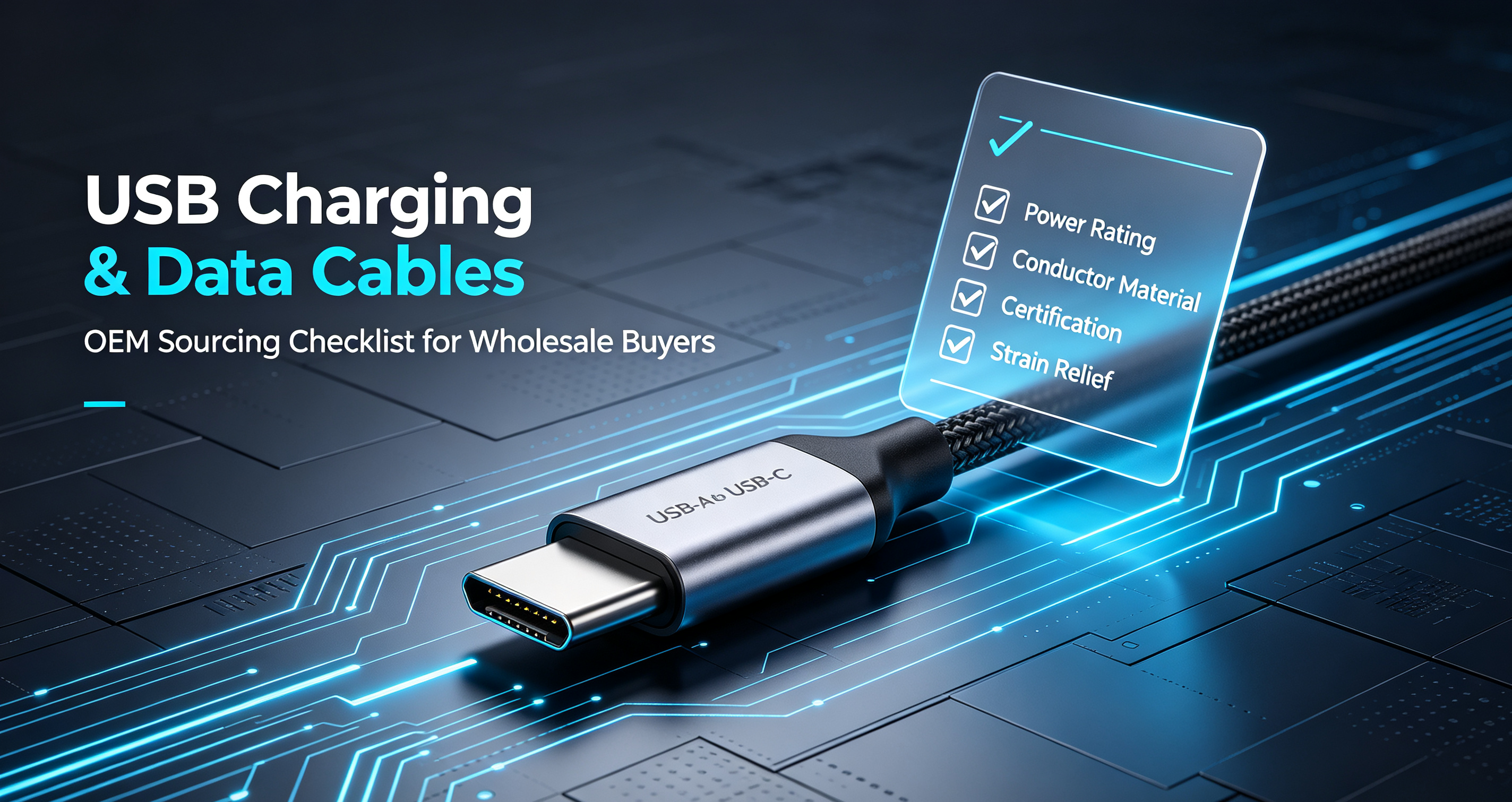
Confirm maximum wattage: 18W, 30W, 60W, 100W PD or higher. High-power PD cables require a proper E-Marker chip inside to negotiate safe power delivery. Without correct E-Marker configuration, fast charging will not activate, and overheating risk increases.
Cable Length Range
Longer cables bring higher voltage drop. For cables over 1 meter used for high-power charging, thicker AWG conductors are mandatory to avoid power loss and temperature rise.
Cable Jacket Material Selection
The outer jacket directly determines hand-feel, anti-twist performance, and service life.
Nylon Braided
Advantages: High abrasion resistance, anti-knot, premium visual texture, perfect for retail private-label products.
Disadvantages: Higher unit cost than ordinary PVC.
Silicone Jacket
Advantages: Ultra-soft touch, anti-dust, low-temperature resistance, popular for consumer-oriented gift-box sets.
Disadvantages: Relatively easy to catch dust under heavy-usage environments.
Standard PVC
Advantages: Economical, stable molding performance, suitable for large-volume cost-sensitive projects.
Disadvantages: Hardens gradually under long-time cold-cycle usage.
Internal Conductor Standard
Pure Copper vs Copper-Clad Aluminum (CCA)
Many low-cost bulk cables adopt CCA conductors to cut cost. CCA raises internal resistance: you will get obvious voltage drop, slower charging speed, and extra heat generation, especially for long-size or high-current cables. For formal OEM wholesale projects, pure-copper conductors remain the reliable option.
Strain-Relief / Over-Molding Design
The connector-cable joint is the most frequently failed position for USB cables in real-world application. Repeated plug-and-unplug and bending stress concentrate on this area.
Good OEM cables apply reinforced over-molded strain-relief structure, which protects internal solder joints from fatigue fracture, extending product cycle life significantly.
Certification & Compliance for Overseas Shipment
If you ship goods to North America, European Union, and other regulated markets, compliance documents cannot be ignored.
- USB-IF certification: Proves USB protocol compliance, avoids customs hold-up risk for retail-grade products.
- CE, RoHS: Mandatory documents for EU market import.
- MFi certification: Required for Lightning interface cables selling to Apple-device end-users.
>
> Note: Request factory to provide valid certification copies. Do not only accept supplier self-claimed statements.
Private-Label OEM Customizable Options
Qualified cable OEM manufacturer supports multi-dimension customization for your brand:
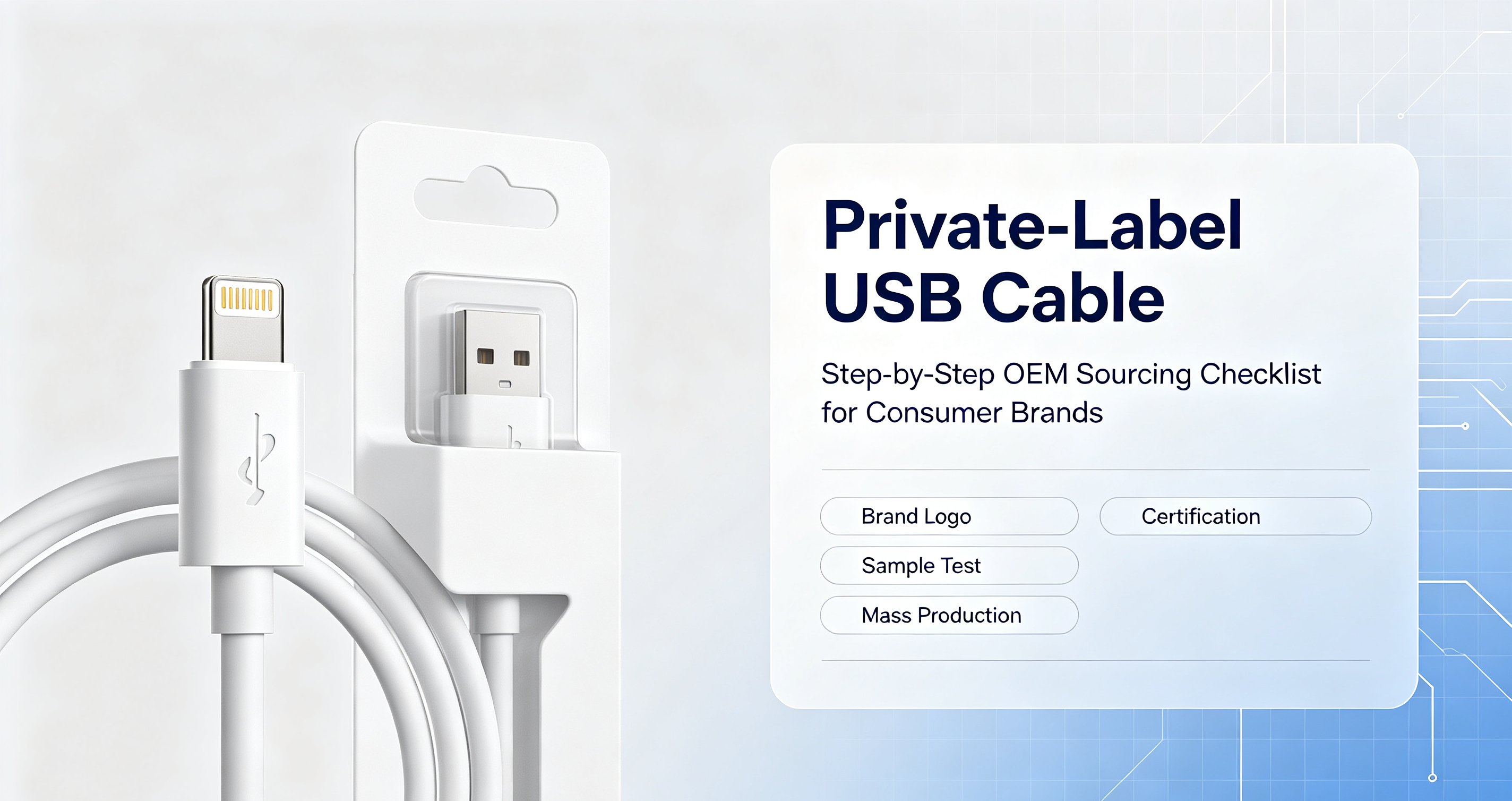
- Custom cable jacket color, matched to your brand system color palette.
- Laser-engraved or silk-screen printed logo on connector housing.
- Custom-molded over-mold shape for exclusive appearance.
- Custom retail-ready packaging: color boxes, blister cards, poly-bag options.
- Flexible MOQ for semi-custom and fully custom cable solutions.
Common Bulk Order Risk Points to Avoid
1. Spec Ambiguity on Quotation Sheet
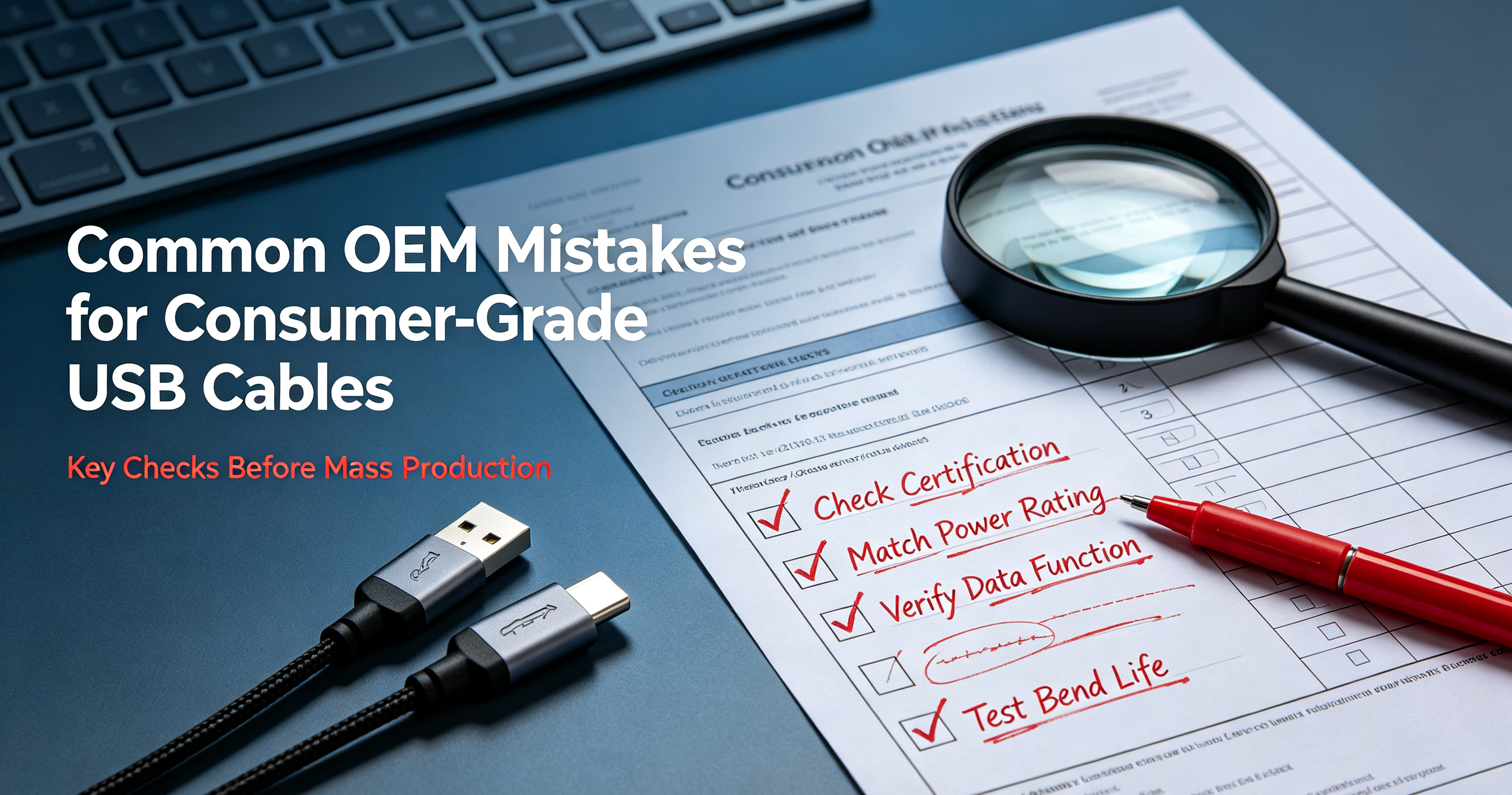
Do not only write “USB-C cable 1m”. Write clearly: power rating, data-sync or charging-only, jacket material, conductor requirement, and certification requirement. Lock all specifications on a sample approval document before mass production.
2. Sample vs Mass Order Inconsistency
Confirm the factory keeps your approved sample on file, and arranges batch sampling inspection during mass production.
3. Ignore Mechanical Durability Test
Ask supplier for bending-life test report. Good-quality USB cables usually pass thousands of bending cycles without internal wire breakage.
Final Thoughts
Low unit price never equals good value for USB cable OEM business. Poor-quality cables cause end-user complaints, brand reputation loss, and even safety-related risks. Spend time on specification sorting and sample validation in the early phase, and you will reduce a lot of after-sales trouble in later wholesale operation.
Get A Quote to discuss your custom USB charging and data cable OEM project requirements.