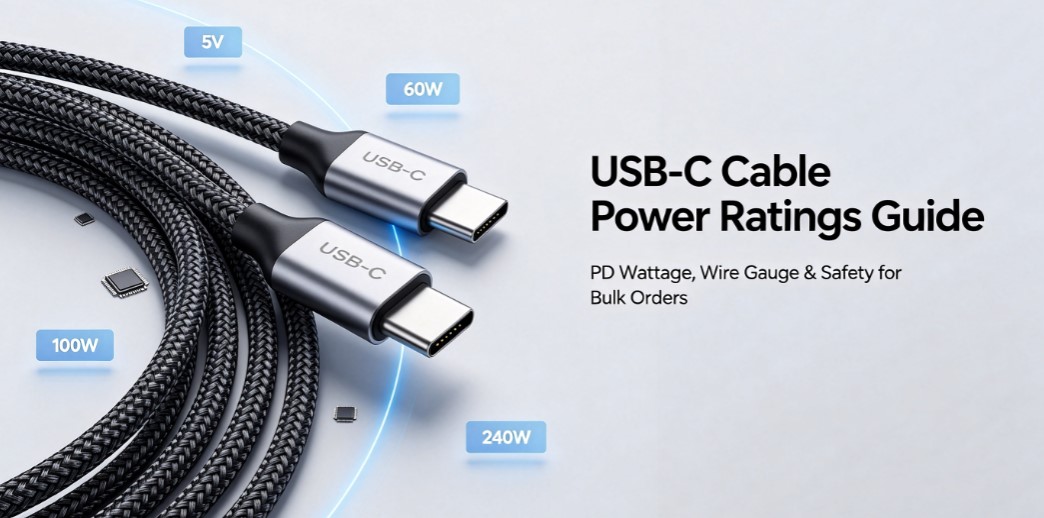
This guide explains how USB-C wattage ratings are actually determined, and what US brand buyers and importers need to verify on the specification sheet before placing an order.
Where the Wattage Number Comes From
USB-C Power Delivery (PD) negotiates voltage and current between the charger, the cable and the device. The wattage ceiling is the lowest of the three. The cable sets two hard limits:
- Current limit — decided by the copper conductor size and, above 3A, by an E-marker chip.
- Voltage limit — decided by the insulation, connector rating and E-marker data.
Wattage is simply volts × amps. The PD standard defines fixed voltage steps: 5V, 9V, 15V, 20V under PD 3.0, and then 28V, 36V and 48V added by PD 3.1 Extended Power Range (EPR). That is why a cable can be labelled "5A" and still be limited to 100W — 5A × 20V = 100W. Only a cable rated for the higher EPR voltages can reach 140W, 180W or 240W.
The Three Wattage Tiers Buyers Actually Order
60W (20V / 3A) — phones, tablets, small accessories. This is the volume tier for US retail and e-commerce bundles. Most smartphone fast-charging runs between 18W and 30W, so a 60W cable has headroom. A 60W-rated cable does not legally require an E-marker chip, though we fit one on any cable that might be used with a laptop to avoid customer complaints.
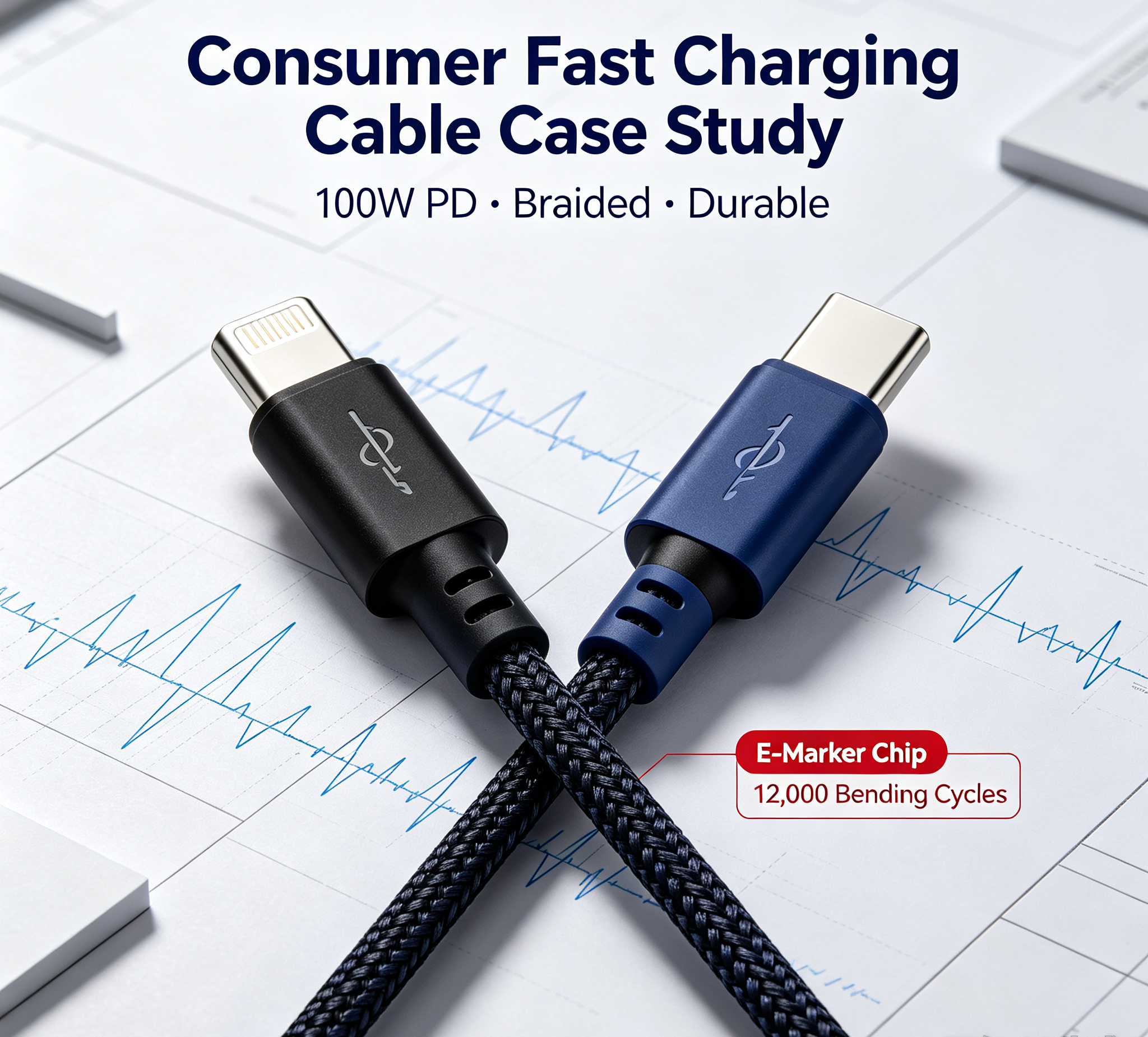
100W (20V / 5A) — laptops, docking stations, power banks. 100W is the classic "full-feature" USB-C cable and the most commonly specified rating for US B2B and retail buyers selling to laptop users. It requires:
- an E-marker (electronically marked cable) chip that declares 5A capability;
- heavier power conductors — typically around 20AWG for the VBUS pair;
- a construction that passes the temperature-rise requirements of UL 9990 at 5A.
140W–240W (EPR, up to 48V / 5A) — high-power laptops and workstations. EPR cables must be individually identified by the E-marker as EPR-capable. Buying an "EPR" cable that lacks the chip is the single most common cause of a laptop not reaching its advertised charge speed.
Why the E-Marker Chip Is Not Optional Above 60W
A USB-C port defaults to 3A (about 60W) unless the cable tells it otherwise. The E-marker is a tiny chip embedded in the cable's connector that reports, over the configuration channel, the cable's current rating and voltage capability. Without it, a host device has no way to know the cable is safe at 5A and will refuse to go above 3A.
For US market compliance, the E-marker data must match the cable's real rating. UL 9990 explicitly requires that "the electronic marker in the cable matches the rating and the relevant USB Power Delivery technology" — a cable that advertises 100W but carries a 3A marker is a compliance failure, not just a performance problem.
Wire Gauge: The Physical Limit Behind the Rating
The wattage label is only honest if the copper can carry the current without excessive voltage drop or heat. For a 1-metre USB-C cable:
| Rating | Typical VBUS gauge | Notes |
|---|---|---|
| 60W / 3A | 22–24AWG | Fine for short consumer cables |
| 100W / 5A | 20AWG | Standard for laptop-class cables |
| 240W / 5A EPR | 20AWG or heavier, thicker insulation | Higher voltage needs more insulation, not just copper |
Voltage drop rises with length as well as current. A 3ft (1m) 100W cable and a 10ft (3m) 100W cable need different copper to hit the same charge performance — which is why we publish a voltage-drop figure rather than only a wattage number. For the full relationship between gauge, current and drop, see our guide to USB cable AWG and voltage drop.
How to Verify a Wattage Rating Before You Order
When a factory quotes a wattage, ask for four things:
1. The E-marker read-out. A photo of the chip read on a USB PD analyser, showing the negotiated 100W or 240W on a test load.
2. The conductor specification — AWG for VBUS and GND, and the strand count.
3. A voltage-drop measurement at rated current over the full length, not a theoretical calculation.
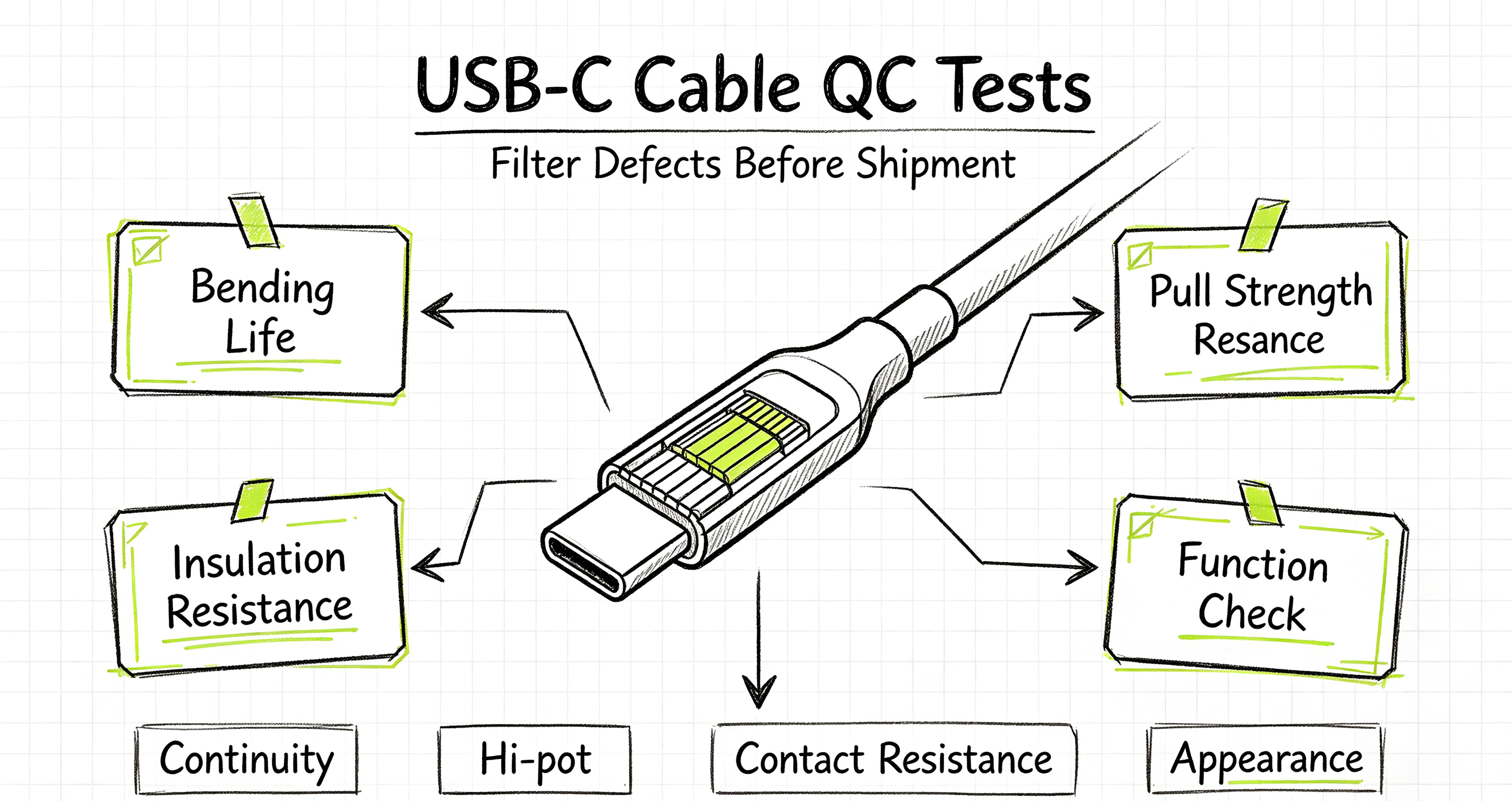
4. A UL 9990 test report if the cable will be sold in the US on Amazon or in retail, covering temperature rise, dielectric withstand and fault current.
If a supplier cannot produce the first two, the wattage on the packaging is marketing, not engineering.
US Market Compliance Notes
- Amazon US requires a UL 9990 report for Type-C cables; listings without one are removed. The report may be issued by any NRTL-accredited lab, not only UL.
- Retail buyers increasingly ask for UL 9990 because a cable that fails the 8A fault-current test is a genuine fire risk in a customer's home.
- Packaging claims must match the E-marker. Overstating wattage invites returns, one-star reviews about "doesn't fast charge," and platform compliance flags.
Common Wattage Mistakes
- Assuming any USB-C cable does 100W. Most cables in a drawer are 60W or lower, and many cheap cables have no E-marker at all.
- Buying 240W for a phone. It works, but you are paying for copper and a chip the device cannot use. 60W is the commercially sensible tier for phone bundles.
- Ignoring length. A 10ft cable with the same gauge as a 3ft cable will show noticeably slower charging on a laptop.
- Confusing charger wattage with cable wattage. A 140W charger cannot deliver 140W through a 60W cable. This is the number-one customer complaint we see from US e-commerce sellers.
FAQ
Can a 100W USB-C cable charge a 240W laptop?
It will charge it, but capped at 100W. The laptop negotiates the highest power all three parts support, so performance drops to the cable's ceiling.
Does a higher-wattage cable charge a phone faster?
No. The phone draws only what its charging circuit allows. A 240W cable will not charge a phone faster than a 60W cable.
Is a 100W cable safe on a 5W charger?
Yes. Power is negotiated downward as well as upward. The cable simply carries a lower current.
How can I tell if a cable has an E-marker?
Use a USB PD analyser or tester. It will report the cable's advertised current and voltage. Consumer "USB-C tester" dongles sold in the US do this in a few seconds.
What gauge do I need for a 6ft 100W cable?
Generally 20AWG for the VBUS pair. Longer lengths may need heavier gauge or a shorter rated length to keep voltage drop acceptable.
Sourcing a Correctly Rated Cable
If you are specifying a USB-C cable for the US market, send us your target wattage, length and whether it needs to pass UL 9990 for Amazon. We will match the conductor gauge and E-marker to your rating, run a voltage-drop test at full current, and supply the test data before mass production. Start with our custom USB charging cable MOQ guide or contact our engineers with your specification.