The Starting Point: A Winning Amazon Listing
The brand came to us with a cable already performing well online: a 100W braided USB-C to USB-C cable in three lengths and two colors, private-labeled with custom packaging. Amazon sales were steady and reviews were healthy. The owner's goal was simple — a buyer at a regional electronics chain had shown interest, and the brand wanted to be "retail ready" within one season.
Online, the product only had to survive comparison on a screen. Retail would demand far more before it ever reached a shelf. This brand's Amazon-era setup echoed the pattern described in our earlier custom 100W USB-C cable e-commerce case study, but retail readiness turned out to be a bigger rebuild than expected.
What Retail Buyers Actually Ask For
The first buyer meeting produced a checklist no Amazon listing had ever required:
- Retail-ready packaging — a hanging carton with a scannable UPC, brand story panel, and spec table, not a poly bag with an insert card.
- A price file with margin room — keystone pricing means the wholesale price must be roughly half the shelf price, which forced a hard look at unit cost.
- Compliance documentation — certificates and test reports attached to the purchase order, not linked from a listing page.
- Logistics terms — carton quantities, master-carton labeling, and floor-ready delivery to the chain's distribution center.
Rebuilding the Packaging and Labeling
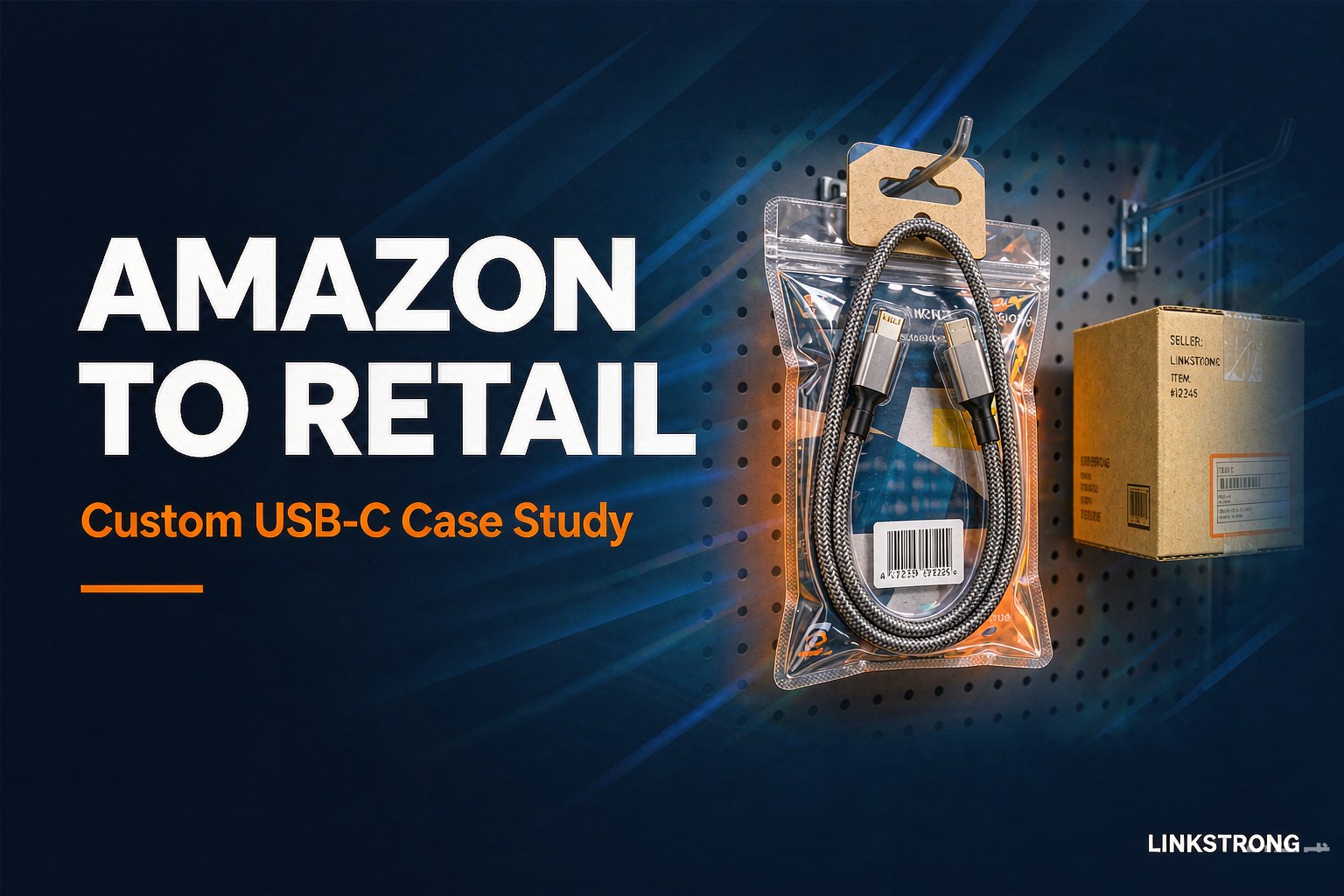
The original Amazon box was a slim white sleeve; it looked premium in product photos but vanished on a cluttered peg. We rebuilt the package around a hanging box with a die-cut hook, a front panel that answers three questions in two seconds (what it is, how much power, which devices), and a printed spec table replacing the folded insert card. Our overview of USB cable packaging options for brand buyers breaks down the main structures and where each one fits.
Two details mattered more than expected. First, the UPC had to be printed — not a sticker — because the retailer's receiving process rejected stickered cartons. Second, multilingual copy (English plus Spanish) became mandatory once the chain confirmed distribution across southern states.
Compliance and Audit Paperwork
The retailer required a compliance file with each new item: UL 9990 test report, FCC/CE declarations, RoHS, and a Prop 65 material statement, plus proof of product liability insurance. The brand had none of this organized — the underlying work existed, but the documents were scattered across email threads from the original Amazon launch.
Compiling a single, version-controlled compliance folder took about three weeks and became the single biggest reason the deal closed. A buyer reading a tidy, complete file makes a very different risk judgment than one waiting on follow-up emails. If your certification base needs strengthening, our guide to UL 9990 for US cable buyers explains what that report covers and why retailers increasingly ask for it by name.
Program Changes at the Factory
Retail also changed the production plan. Order sizes shifted from continuous small Amazon replenishment to fewer, larger POs with fixed delivery windows, which meant reserving capacity and holding safety stock. Carton specifications, pallet patterns, and master-carton labels were standardized to the retailer's routing guide. Finally, we froze the cable's bill of materials and locked change control, because a silent material swap that is invisible online becomes a serious problem when the same SKU sits in five hundred stores.
Results and Lessons for Other Brands
Within two quarters, the brand was in 140 stores across two regional chains, with retail now about 35% of revenue and growing faster than the Amazon channel. The three lessons that transfer to almost any brand:
- Start the compliance file before the buyer asks — it is the longest lead-time item on the list.
- Price for retail from day one, even if you only sell on Amazon today; retrofitting margin is far harder than leaving room early.
- Choose a factory that has shipped to retail before. Cartons, labels, and delivery windows are learned skills, not assumptions.
If you are weighing the same move — or want a custom cable program built to survive both channels — contact the LINKSTRONG team and we will share the packaging, compliance, and production templates we use for US retail programs.